In my previous blog entry, I talked a bit about one of my favorite books, The Scarlet Pimpernel by Baroness Emma Orczy. Here are some of my favorite scenes that made me fall in love with the character of Sir Percy Blakeney. If you haven’t read the book yet and intend to do so – do NOT read this. SPOILER ALERT!
From Chapter 7 – The Secret Orchard
This is the conversation between Marguerite and her brother Armand, where she admitted her estrangement to her husband, and the selfish reasons why she married him in the first place when they did not seem intellectually matched.
“Does Sir Percy Blakeney know that… I mean, does he know the part you played in the arrest of the Marquis de St. Cyr?”
She laughed – a mirthless, bitter, contemptuous laugh, which was like a jarring chord in the music of her voice.
“That I denounced the Marquis de St. Cyr, you mean, to the tribunal that ultimately sent him and all his family to the guillotine? Yes, he does know… I told him after I married him…”
“You told him all the circumstances – which so completely exonerated you from any blame?”
“It was too late to talk of ‘circumstances’; he heard the story from other sources; my confession came too tardily, it seems. I could no longer plead extenuating circumstances: I could not demean myself by trying to explain -“
“And?”
“And now I have the satisfaction, Armand, of knowing that the biggest fool in England has the most complete contempt for his wife.”
She spoke with vehement bitterness this time, and Armand St. Just, who loved her so dearly, felt that he had placed a somewhat clumsy finger upon an aching wound.
“But Sir Percy loved you, Margot,” he repeated gently.
“Loved me? – Well, Armand, I thought at one time that he did, or I should not have married him. I daresay,” she added, speaking very rapidly, as if she were about to lay down a heavy burden, which had oppressed her for months, “I daresay that even you thought-as everybody else did – that I married Sir Percy because of his wealth – but I assure you, dear, that it was not so. He seemed to worship me with a curious intensity of concentrated passion, which went straight to my heart. I had never loved any one before, as you know, and I was four-and-twenty then – so I naturally thought that it was not in my nature to love. But it has always seemed to me that it must be heavenly to be loved blindly, passionately, wholly… worshipped, in fact – and the very fact that Percy was slow and stupid was an attraction for me, as I thought he would love me all the more. A clever man would naturally have other interests, an ambitious man other hopes… I thought that a fool would worship, and think of nothing else. And I was ready to respond, Armand; I would have allowed myself to be worshipped, and given infinite tenderness in return… “
From Chapter 11 – Lord Grenville’s Ball
This is during the Lord Grenville’s ball where the Prince of Wales, a French spy named Chauvelin (who was sent to England to find out the identity of the Scarlet Pimpernel) and the Blakeneys meet.
“Ah, Monseigneur,” said Chauvelin, significantly, “rumour has it in France that your Highness could–an you would–give the truest account of that enigmatical wayside flower.”
He looked quickly and keenly at Marguerite as he spoke; but she betrayed no emotion, and her eyes met his quite fearlessly.
“Nay, man,” replied the Prince, “my lips are sealed! And the members of the league jealously guard the secret of their chief… so his fair adorers have to be content with worshipping a shadow. Here in England, Monsieur,” he added, with wonderful charm and dignity, “we but name the Scarlet Pimpernel, and every fair cheek is suffused with a blush of enthusiasm. None have seen him save his faithful lieutenants. We know not if he be tall or short, fair or dark, handsome or ill-formed; but we know that he is the bravest gentleman in all the world, and we all feel a little proud, Monsieur, when we remember that he is an Englishman.”
“Ah, Monsieur Chauvelin,” added Marguerite, looking almost with defiance across at the placid, sphinx-like face of the Frenchman, “His Royal Highness should add that we ladies think of him as of a hero of old… we worship him… we wear his badge… we tremble for him when he is in danger, and exult with him in the hour of his victory.”
Chauvelin did no more than bow placidly both to the Prince and to Marguerite; he felt that both speeches were intended – each in their way – to convey contempt or defiance. The pleasure-loving, idle Prince he despised: the beautiful woman, who in her golden hair wore a spray of small red flowers composed of rubies and diamonds – her he held in the hollow of hand: he could afford to remain silent and to wait events.
A long, jovial, inane laugh broke the sudden silence which had fallen over everyone.
“And we poor husbands,” came in slow, affected accents from gorgeous Sir Percy, “we have to stand by… while they worship a demmed shadow.”
Everyone laughed – the Prince more loudly than anyone. The tension of subdued excitement was relieved, and the next moment everyone was laughing and chatting merrily as the gay crowd broke up and dispersed in the adjoining rooms.
From Chapter 12 – The Scrap of Paper
This was during the same ball, and contains the short funny poem that Sir Percy invented.
There he stood, the moral support, the cool-headed adviser, surrounded by a crowd of brainless, empty-headed young fops, who were even now repeating from mouth to mouth, and with every sign of the keenest enjoyment, a doggerel quatrain which he had just given forth. Everywhere the absurd, silly words met her: people seemed to have little else to speak about, even the Prince had asked her, with a little laugh, whether she appreciated her husband’s latest poetic efforts.
“All done in the tying of a cravat,” Sir Percy had declared to his clique of admirers.
“We seek him here, we seek him there,
Those Frenchies seek him everywhere.
Is he in heaven?–Is he in hell?
That demmed, elusive Pimpernel?”
From Chapter 16 – Richmond
This was after the drive home from the ball, and Marguerite was feeling guilty and troubled about how she helped Chauvelin in his quest to unmask the Scarlet Pimpernel. She also tried to rekindle her husband’s love.
“Sir Percy.”
“Your servant, Madame.”
“Is it possible that love can die?” she said with sudden, unreasoning vehemence. “Methought that the passion which you once felt for me would outlast the span of human life. Is there nothing left of that love, Percy… which might help you… to bridge over that sad estrangement?”
His massive figure seemed, while she spoke thus to him, to stiffen still more, the strong mouth hardened, a look of relentless obstinacy crept into the habitually lazy blue eyes.
“With what object, I pray you, Madame?” he asked coldly.
“I do not understand you.”
“Yet `tis simple enough,” he said with sudden bitterness, which seemed literally to surge through his words, though he was making visible efforts to suppress it, “I humbly put the question to you, for my slow wits are unable to grasp the cause of this, your ladyship’s sudden new mood. Is it that you have the taste to renew the devilish sport which you played so successfully last year? Do you wish to see me once more a love-sick suppliant at your feet, so that you might again have the pleasure of kicking me aside, like a troublesome lap-dog?”
She had succeeded in rousing him for the moment: and again she looked straight at him, for it was thus she remembered him a year ago.
“Percy! I entreat you!” she whispered, “can we not bury the past?”
“Pardon me, Madame, but I understood you to say that your desire was to dwell in it.”
“Nay! I spoke not of that past, Percy!” she said, while a tone of tenderness crept into her voice. “Rather did I speak of a time when you loved me still! and I… oh! I was vain and frivolous; your wealth and position allured me: I married you, hoping in my heart that your great love for me would beget in me a love for you… but, alas!…”
The moon had sunk low down behind a bank of clouds. In the east a soft grey light was beginning to chase away the heavy mantle of the night. He could only see her graceful outline now, the small queenly head, with its wealth of reddish golden curls, and the glittering gems forming the small, star-shaped, red flower which she wore as a diadem in her hair.
“Twenty-four hours after our marriage, Madame, the Marquis de St. Cyr and all his family perished on the guillotine, and the popular rumour reached me that it was the wife of Sir Percy Blakeney who helped to send them there.”
“Nay! I myself told you the truth of that odious tale.”
“Not till after it had been recounted to me by strangers, with all its horrible details.”
“And you believed them then and there,” she said with great vehemence, “without a proof or question – you believed that I, whom you vowed you loved more than life, whom you professed you worshipped, that I could do a thing so base as these strangers chose to recount. You thought I meant to deceive you about it all – that I ought to have spoken before I married you: yet, had you listened, I would have told you that up to the very morning on which St. Cyr went to the guillotine, I was straining every nerve, using every influence I possessed, to save him and his family. But my pride sealed my lips, when your love seemed to perish, as if under the knife of that same guillotine. Yet I would have told you how I was duped! Aye! I, whom that same popular rumour had endowed with the sharpest wits in France! I was tricked into doing this thing, by men who knew how to play upon my love for an only brother, and my desire for revenge. Was it unnatural?”
Her voice became choked with tears. She paused for a moment or two, trying to regain some sort of composure. She looked appealingly at him, almost as if he were her judge. He had allowed her to speak on in her own vehement, impassioned way, offering no comment, no word of sympathy: and now, while she paused, trying to swallow down the hot tears that gushed to her eyes, he waited, impassive and still. The dim, grey light of early dawn seemed to make his tall form look taller and more rigid. The lazy, good-natured face looked strangely altered. Marguerite, excited, as she was, could see that the eyes were no longer languid, the mouth no longer good-humoured and inane. A curious look of intense passion seemed to glow from beneath his drooping lids, the mouth was tightly closed, the lips compressed, as if the will alone held that surging passion in check.
Marguerite Blakeney was, above all, a woman, with all a woman’s fascinating foibles, all a woman’s most lovable sins. She knew in a moment that for the past few months she had been mistaken: that this man who stood here before her, cold as a statue, when her musical voice struck upon his ear, loved her, as he had loved her a year ago: that his passion might have been dormant, but that it was there, as strong, as intense, as overwhelming, as when first her lips met his in one long, maddening kiss.
Pride had kept him from her, and, woman-like, she meant to win back that conquest which had been hers before. Suddenly it seemed to her that the only happiness life could every hold for her again would be in feeling that man’s kiss once more upon her lips.
“Listen to the tale, Sir Percy,” she said, and her voice was low, sweet, infinitely tender. “Armand was all in all to me! We had no parents, and brought one another up. He was my little father, and I, his tiny mother; we loved one another so. Then one day–do you mind me, Sir Percy? the Marquis de St. Cyr had my brother Armand thrashed – thrashed by his lacqueys – that brother whom I loved better than all the world! And his offence? That he, a plebeian, had dared to love the daughter of the aristocrat; for that he was waylaid and thrashed. . .thrashed like a dog within an inch of his life! Oh, how I suffered! his humiliation had eaten into my very soul! When the opportunity occurred, and I was able to take my revenge, I took it. But I only thought to bring that proud marquis to trouble and humiliation. He plotted with Austria against his own country. Chance gave me knowledge of this; I spoke of it, but I did not know – how could I guess? – they trapped and duped me. When I realised what I had done, it was too late.”
“It is perhaps a little difficult, Madame,” said Sir Percy, after a moment of silence between them, “to go back over the past. I have confessed to you that my memory is short, but the thought certainly lingered in my mind that, at the time of the Marquis’ death, I entreated you for an explanation of those same noisome popular rumours. If that same memory does not, even now, play me a trick, I fancy that you refused me all explanation then, and demanded of my love a humiliating allegiance it was not prepared to give.”
“I wished to test your love for me, and it did not bear the test. You used to tell me that you drew the very breath of life but for me, and for love of me.”
“And to probe that love, you demanded that I should forfeit mine honour,” he said, whilst gradually his impassiveness seemed to leave him, his rigidity to relax; “that I should accept without murmur or question, as a dumb and submissive slave, every action of my mistress. My heart overflowing with love and passion, I asked for no explanation – I waited for one, not doubting – only hoping. Had you spoken but one word, from you I would have accepted any explanation and believed it. But you left me without a word, beyond a bald confession of the actual horrible facts; proudly you returned to your brother’s house, and left me alone… for weeks… not knowing, now, in whom to believe, since the shrine, which contained my one illusion, lay shattered to earth at my feet.”
From Chapter 31 – The Escape
This is the denouement of the story, where Marguerite first comes face to face with Sir Percy – also known as the Scarlet Pimpernel, who was disguised as a Jew. Under disguise, he was beaten up by the men of Chauvelin, while his wife (who had not recognized him at all) watched nearby.
The physical pain of utter weariness was so great, that she hoped confidently her tired body could rest here for ever, after all the turmoil, the passion, and the intrigues of the last few days–here, beneath that clear sky, within sound of the sea, and with this balmy autumn breeze whispering to her a last lullaby. All was so solitary, so silent, like unto dreamland. Even the last faint echo of the distant cart had long ago died away, afar.
Suddenly… a sound… the strangest, undoubtedly, that these lonely cliffs of France had ever heard, broke the silent solemnity of the shore.
So strange a sound was it that the gentle breeze ceased to murmur, the tiny pebbles to roll down the steep incline! So strange, that Marguerite, wearied, overwrought as she was, thought that the beneficial unconsciousness of the approach of death was playing her half-sleeping senses a weird and elusive trick.
It was the sound of a good, solid, absolutely British “Damn!”
The sea gulls in their nests awoke and looked round in astonishment; a distant and solitary owl set up a midnight hoot, the tall cliffs frowned down majestically at the strange, unheard-of sacrilege.
Marguerite did not trust her ears. Half-raising herself on her hands, she strained every sense to see or hear, to know the meaning of this very earthly sound.
All was still again for the space of a few seconds; the same silence once more fell upon the great and lonely vastness.
Then Marguerite, who had listened as in a trance, who felt she must be dreaming with that cool, magnetic moonlight overhead, heard again; and this time her heart stood still, her eyes large and dilated, looked round her, not daring to trust her other sense.
“Odd’s life! but I wish those demmed fellows had not hit quite so hard!”
This time it was quite unmistakable, only one particular pair of essentially British lips could have uttered those words, in sleepy, drawly, affected tones.
“Damn!” repeated those same British lips, emphatically. “Zounds! but I’m as weak as a rat!”
In a moment Marguerite was on her feet.
Was she dreaming? Were those great, stony cliffs the gates of paradise? Was the fragrant breath of the breeze suddenly caused by the flutter of angels’ wings, bringing tidings of unearthly joys to her, after all her suffering, or–faint and ill–was she the prey of delirium?
She listened again, and once again she heard the same very earthly sounds of good, honest British language, not the least akin to whisperings from paradise or flutter of angels’ wings.
She looked round her eagerly at the tall cliffs, the lonely hut, the great stretch of rocky beach. Somewhere there, above or below her, behind a boulder or inside a crevice, but still hidden from her longing, feverish eyes, must be the owner of that voice, which once used to irritate her, but now would make her the happiest woman in Europe, if only she could locate it.
“Percy! Percy!” she shrieked hysterically, tortured between doubt and hope, “I am here! Come to me! Where are you? Percy! Percy!…”
“It’s all very well calling me, m’dear!” said the same sleepy, drawly voice, “but odd’s life, I cannot come to you: those demmed frog-eaters have trussed me like a goose on a spit, and I am weak as a mouse… I cannot get away.”
And still Marguerite did not understand. She did not realise for at least another ten seconds whence came that voice, so drawly, so dear, but alas! with a strange accent of weakness and of suffering. There was no one within sight… except by that rock… Great God!… the Jew! … Was she mad or dreaming?…
His back was against the pale moonlight, he was half crouching, trying vainly to raise himself with his arms tightly pinioned. Marguerite ran up to him, took his head in both her hands… and look straight into a pair of blue eyes, good-natured, even a trifle amused – shining out of the weird and distorted mask of the Jew.
“Percy!… Percy!… my husband!” she gasped, faint with the fullness of her joy. “Thank God! Thank God!”
“La! m’dear,” he rejoined good-humouredly, “we will both do that anon, an you think you can loosen these demmed ropes, and release me from my inelegant attitude.”
She had no knife, her fingers were numb and weak, but she worked away with her teeth, while great welcome tears poured from her eyes, onto those poor, pinioned hands.
“Odd’s life!” he said, when at last, after frantic efforts on her part, the ropes seemed at last to be giving way, “but I marvel whether it has ever happened before, that an English gentleman allowed himself to be licked by a demmed foreigner, and made no attempt to give as good as he got.”
It was very obvious that he was exhausted from sheer physical pain, and when at last the rope gave way, he fell in a heap against the rock.
Marguerite looked helplessly round her.
“Oh! for a drop of water on this awful beach!” she cried in agony, seeing that he was ready to faint again.
“Nay, m’dear,” he murmured with his good-humoured smile, “personally I should prefer a drop of good French brandy! an you’ll dive in the pocket of this dirty old garment, you’ll find my flask… I am demmed if I can move.”
When he had drunk some brandy, he forced Marguerite to do likewise.
“La! that’s better now! Eh! little woman?” he said, with a sigh of satisfaction. “Heigh-ho! but this is a queer rig-up for Sir Percy Blakeney, Bart., to be found in by his lady, and no mistake. Begad!” he added, passing his hand over his chin, “I haven’t been shaved for nearly twenty hours: I must look a disgusting object. As for these curls…”
And laughingly he took off the disfiguring wig and curls, and stretched out his long limbs, which were cramped from many hours’ stooping. Then he bent forward and looked long and searchingly into his wife’s blue eyes.
“Percy,” she whispered, while a deep blush suffused her delicate cheeks and neck, “if you only knew…”
“I do know, dear… everything,” he said with infinite gentleness.
“And can you ever forgive?”
“I have naught to forgive, sweetheart; your heroism, your devotion, which I, alas! so little deserved, have more than atoned for that unfortunate episode at the ball.”
“Then you knew?…” she whispered, “all the time…”
“Yes!” he replied tenderly, “I knew… all the time… But, begad! had I but known what a noble heart yours was, my Margot, I should have trusted you, as you deserved to be trusted, and you would not have had to undergo the terrible sufferings of the past few hours, in order to run after a husband, who has done so much that needs forgiveness.”

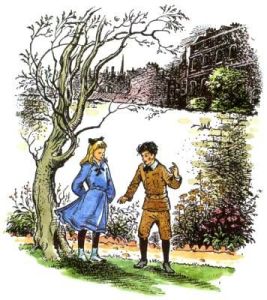 The magician’s nephew refers to Digory, the main character in this book, who will become Professor Kirke in the next book.
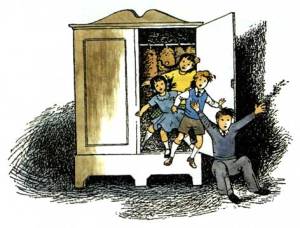 The Lion in the title is of course, Aslan, who is the parallel of Jesus in that world. The witch is Jadis (whom we first meet in MN) who used to rule in the dead world of Charn. At the time of this story, Jadis has been known in all Narnia as the white witch, and represents all that is evil in the world. The wardrobe was the way in which the four Pevensies – Peter, Susan, Edmund and Lucy – were able to enter the world of Narnia.
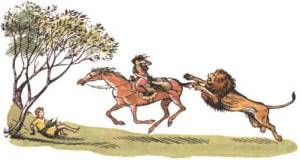 The horse in the title should get an award for the longest, most interesting name in all Narnia – Breeny-heeny-breeny-hoohy-ha, or Bree for short. He is a Talking Horse who was captured in his youth and was forced to live and work in the distant land of Calormen. Desiring to return to Narnia, he escaped with a boy named Shasta. The reason why the title is “The Horse and His Boy” instead of “The Boy and His Horse” is that Bree pointed out early on to the proud Aravis, the girl who joined them in their escape, that Talking Horses are free Narnians, and so do not belong to anybody.
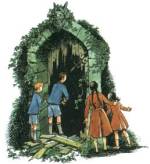 This is the most obvious of all the titles, and needs the least explanation. The book tells of the adventures of Prince Caspian the Tenth, and how he became the rightful king of Narnia against his dangerous Uncle Miraz.
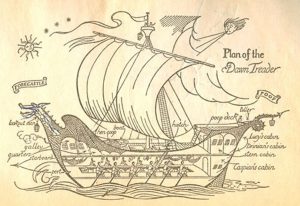 The title pertains to the adventures of the Dawn Treader, which was the name of the ship that King Caspian built in order to find the seven lords (his father’s friends) who sailed off to the east during the time of Miraz. This is a proper adventure story, with exciting things happening in each island.
 The silver chair in the title pertains to the magical chair which was used by the Lady of the Green Kirtle, also called the Queen of the Underland or the Emerald Witch. She had the enchanted Prince Rilian, who was the son of King Caspian the Tenth, tied down on this chair during the hour when the enchantment was lifted and he returned to his right mind. This book introduces my all-time favorite literary character – a marshwiggle named Puddleglum.
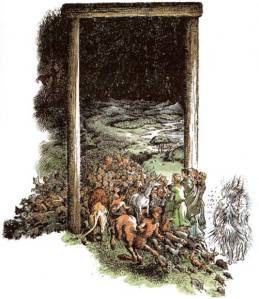 The title pertains to the final battle in the history of Narnia, which was between the Calormene army and the Narnians who fought on the side of King Tirian. It is the darkest story in the series, but has the most beautiful ending.

 #1 The Adventure of the Speckled Band.
 Sunny Feels
