Tag Archives: favourite-quotes

Favorite Peeta Quotes from Catching Fire

I was pleasantly surprised to notice how much comments and views I got on my blog posts about The Hunger Games. I just re-read the entire trilogy over the weekend, and thought I’d write a post on my favorite Peeta quotes from Catching Fire. You can also check out my favorite Peeta quotes from The Hunger Games here and my favorite Peeta and Katniss moments from Mockingjay here.

Wounded

After a while I hear footsteps behind me. It’ll be Haymitch, coming to chew me out. It’s not like I don’t deserve it, but I still don’t want to hear it. “I’m not in the mood for a lecture,” I warn the clump of weeds by my shoes.

“I’ll try to keep it brief.” Peeta takes a seat beside me. “I thought you were Haymitch,” I say.

“No, he’s still working on that muffin.” I watch as Peeta positions his artificial leg. “Bad day, huh?” “It’s nothing,” I say.

He takes a deep breath. “Look, Katniss, I’ve been wanting to talk to you about the way I acted on the train. I mean, the last train. The one that brought us home. I knew you had something with Gale. I was jealous of him before I even officially met you. And it wasn’t fair to hold you to anything that happened in the Games. I’m sorry.”

His apology takes me by surprise. It’s true that Peeta froze me out after I confessed that my love for him during the Games was something of an act. But I don’t hold that against him. In the arena, I’d played that romance angle for all it was worth. There had been times when I didn’t honestly know how I felt about him. I still don’t, really.

“I’m sorry, too,” I say. I’m not sure for what exactly. Maybe because there’s a real chance I’m about to destroy him.

“There’s nothing for you to be sorry about. You were just keeping us alive. But I don’t want us to go on like this, ignoring each other in real life and falling into the snow every time there’s a camera around. So I thought if I stopped being so, you know, wounded, we could take a shot at just being friends,” he says.

Losing You

“Peeta, how come I never know when you’re having a nightmare?” I say.

“I don’t know. I don’t think I cry out or thrash around or anything. I just come to, paralyzed with terror,” he says.

“You should wake me,” I say, thinking about how I can interrupt his sleep two or three times on a bad night. About how long it can take to calm me down.

“It’s not necessary. My nightmares are usually about losing you,” he says. “I’m okay once I realize you’re here.”

Her Cousin

“He was poaching. What business is it of hers, anyway?” says the man.

“He’s her cousin.” Peeta’s got my other arm now, but gently. “And she’s my fiancé. So if you want to get to him, expect to go through both of us.”

Just Go to Bed

Someone gives my shoulder a shake and I sit up. I’ve fallen asleep with my face on the table. The white cloth has left creases on my good cheek. The other, the one that took the lash from Thread, throbs painfully. Gale’s dead to the world, but his fingers are locked around mine. I smell fresh bread and turn my stiff neck to find Peeta looking down at me with such a sad expression. I get the sense that he’s been watching us awhile.

“Go on up to bed, Katniss. I’ll look after him now,” he says.

“Peeta. About what I said yesterday, about running—” I begin.

“I know,” he says. “There’s nothing to explain.”

I see the loaves of bread on the counter in the pale, snowy morning light. The blue shadows under his eyes. I wonder if he slept at all. Couldn’t have been long. I think of his agreeing to go with me yesterday, his stepping up beside me to protect Gale, his willingness to throw his lot in with mine entirely when I give him so little in return. No matter what I do, I’m hurting someone. “Peeta—”

“Just go to bed, okay?” he says.

Formal Request

So I give up trying to make friends and go over to the archery range for some sanity. It’s wonderful there, getting to try out all the different bows and arrows. The trainer, Tax, seeing that the standing targets offer no challenge for me, begins to launch these silly fake birds high into the air for me to hit. At first it seems stupid, but it turns out to be kind of fun. Much more like hunting a moving creature. Since I’m hitting everything he throws up, he starts increasing the number of birds he sends airborne. I forget the rest of the gym and the victors and how miserable I am and lose myself in the shooting. When I manage to take down five birds in one round, I realize it’s so quiet I can hear each one hit the floor. I turn and see the majority of the victors have stopped to watch me. Their faces show everything from envy to hatred to admiration.

After training, Peeta and I hang out, waiting for Haymitch and Effie to show up for dinner. When we’re called to eat, Haymitch pounces on me immediately. “So at least half the victors have instructed their mentors to request you as an ally. I know it can’t be your sunny personality.”

“They saw her shoot,” says Peeta with a smile. “Actually, I saw her shoot, for real, for the first time. I’m about to put in a formal request myself.”

The Rest of My Life

Peeta would lose it if he knew I was thinking any of this, so I only say, “So what should we do with our last few days?”

“I just want to spend every possible minute of the rest of my life with you,” Peeta replies.

Freeze

No one bothers us. By late afternoon, I lie with my head on Peeta’s lap, making a crown of flowers while he fiddles with my hair, claiming he’s practicing his knots. After a while, his hands go still. “What?” I ask.

“I wish I could freeze this moment, right here, right now, and live in it forever,” he says.

If It Weren’t for the Baby

“We’re already married,” says Peeta quietly. The crowd reacts in astonishment, and I have to bury my face in the folds of my skirt so they can’t see my confusion. Where on earth is he going with this?

“But … how can that be?” asks Caesar.

“Oh, it’s not an official marriage. We didn’t go to the Justice Building or anything. But we have this marriage ritual in District Twelve. I don’t know what it’s like in the other districts. But there’s this thing we do,” says Peeta, and he briefly describes the toasting.

“Were your families there?” asks Caesar.

“No, we didn’t tell anyone. Not even Haymitch. And Katniss’s mother would never have approved. But you see, we knew if we were married in the Capitol, there wouldn’t be a toasting. And neither of us really wanted to wait any longer. So one day, we just did it,” Peeta says. “And to us, we’re more married than any piece of paper or big party could make us.”

“So this was before the Quell?” says Caesar.

“Of course before the Quell. I’m sure we’d never have done it after we knew,” says Peeta, starting to get upset. “But who could’ve seen it coming? No one. We went through the Games, we were victors, everyone seemed so thrilled to see us together, and then out of nowhere—I mean, how could we anticipate a thing like that?”

“You couldn’t, Peeta.” Caesar puts an arm around his shoulders. “As you say, no one could’ve. But I have to confess, I’m glad you two had at least a few months of happiness together.”

Enormous applause. As if encouraged, I look up from my feathers and let the audience see my tragic smile of thanks. The residual smoke from the feathers has made my eyes teary, which adds a very nice touch.

“I’m not glad,” says Peeta. “I wish we had waited until the whole thing was done officially.”

This takes even Caesar aback. “Surely even a brief time is better than no time?”

“Maybe I’d think that, too, Caesar,” says Peeta bitterly, “if it weren’t for the baby.”

I Need You

“Katniss,” he says softly, “it’s no use pretending we don’t know what the other one is trying to do.” No, I guess there isn’t, but it’s no fun discussing it, either. Well, not for us, anyway. The Capitol viewers will be glued to their sets so they don’t miss one wretched word.

“I don’t know what kind of deal you think you’ve made with Haymitch, but you should know he made me promises as well.” Of course, I know this, too. He told Peeta they could keep me alive so that he wouldn’t be suspicious. “So I think we can assume he was lying to one of us.”

This gets my attention. A double deal. A double promise. With only Haymitch knowing which one is real. I raise my head, meet Peeta’s eyes. “Why are you saying this now?”

“Because I don’t want you forgetting how different our circumstances are. If you die, and I live, there’s no life for me at all back in District Twelve. You’re my whole life,” he says. “I would never be happy again.” I start to object but he puts a finger to my lips. “It’s different for you. I’m not saying it wouldn’t be hard. But there are other people who’d make your life worth living.”

Peeta pulls the chain with the gold disk from around his neck. He holds it in the moonlight so I can clearly see the mockingjay. Then his thumb slides along a catch I didn’t notice before and the disk pops open. It’s not solid, as I had thought, but a locket. And within the locket are photos. On the right side, my mother and Prim, laughing. And on the left, Gale. Actually smiling.

There is nothing in the world that could break me faster at this moment than these three faces. After what I heard this afternoon … it is the perfect weapon.

“Your family needs you, Katniss,” Peeta says.

My family. My mother. My sister. And my pretend cousin Gale. But Peeta’s intention is clear. That Gale really is my family, or will be one day, if I live. That I’ll marry him. So Peeta’s giving me his life and Gale at the same time. To let me know I shouldn’t ever have doubts about it.

Everything. That’s what Peeta wants me to take from him.

I wait for him to mention the baby, to play to the cameras, but he doesn’t. And that’s how I know that none of this is part of the Games. That he is telling me the truth about what he feels.

“No one really needs me,” he says, and there’s no self-pity in his voice. It’s true his family doesn’t need him. They will mourn him, as will a handful of friends. But they will get on. Even Haymitch, with the help of a lot of white liquor, will get on. I realize only one person will be damaged beyond repair if Peeta dies. Me.

“I do,” I say. “I need you.” He looks upset, takes a deep breath as if to begin a long argument, and that’s no good, no good at all, because he’ll start going on about Prim and my mother and everything and I’ll just get confused. So before he can talk, I stop his lips with a kiss.

I feel that thing again. The thing I only felt once before. In the cave last year, when I was trying to get Haymitch to send us food. I kissed Peeta about a thousand times during those Games and after. But there was only one kiss that made me feel something stir deep inside. Only one that made me want more. But my head wound started bleeding and he made me lie down.

This time, there is nothing but us to interrupt us. And after a few attempts, Peeta gives up on talking. The sensation inside me grows warmer and spreads out from my chest, down through my body, out along my arms and legs, to the tips of my being. Instead of satisfying me, the kisses have the opposite effect, of making my need greater. I thought I was something of an expert on hunger, but this is an entirely new kind.

Nothing But Oysters

Johanna keeps watch while Finnick, Peeta, and I clean and lay out the seafood. Peeta’s just pried open an oyster when I hear him give a laugh. “Hey, look at this!” He holds up a glistening, perfect pearl about the size of a pea. “You know, if you put enough pressure on coal it turns to pearls,” he says earnestly to Finnick.

“No, it doesn’t,” says Finnick dismissively. But I crack up, remembering that’s how a clueless Effie Trinket presented us to the people of the Capitol last year, before anyone knew us. As coal pressured into pearls by our weighty existence. Beauty that arose out of pain.

Peeta rinses the pearl off in the water and hands it to me. “For you.” I hold it out on my palm and examine its iridescent surface in the sunlight. Yes, I will keep it. For the few remaining hours of my life I will keep it close. This last gift from Peeta. The only one I can really accept. Perhaps it will give me strength in the final moments.

“Thanks,” I say, closing my fist around it. I look coolly into the blue eyes of the person who is now my greatest opponent, the person who would keep me alive at his own expense. And I promise myself I will defeat his plan.

The laughter drains from those eyes, and they are staring so intensely into mine, it’s like they can read my thoughts. “The locket didn’t work, did it?” Peeta says, even though Finnick is right there. Even though everyone can hear him. “Katniss?”

“It worked,” I say.

“But not the way I wanted it to,” he says, averting his glance. After that he will look at nothing but oysters.
My Favorite Lines from SHERLOCK Season 1 Episode 1 (A Study in Pink)

Think it through next time.

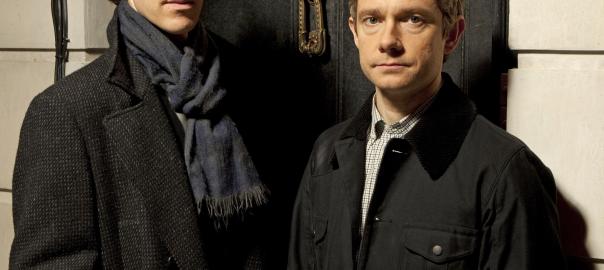
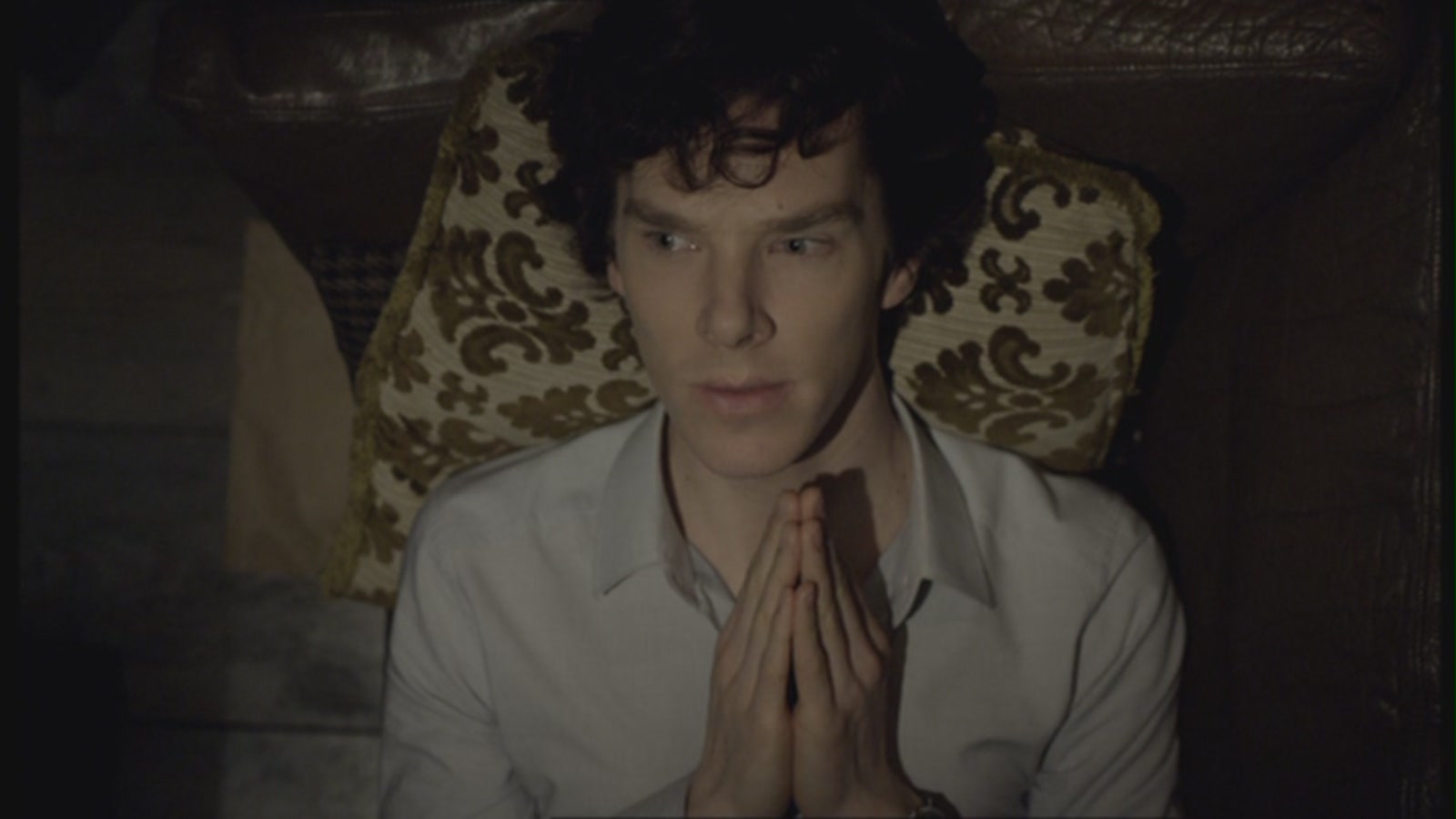
Here are some of my favorite lines from the first episode of Sherlock, A Study in Pink.


John: You asked me to come, I’m assuming it’s important.

Sherlock: Oh – yeah, of course. Can I borrow your phone?

John: My phone?

Sherlock: Always a chance that my number will be recognised. It’s on the website.

John: Mrs Hudson’s got a phone.

Sherlock: Yeah, she’s downstairs. I tried shouting but she didn’t hear.

John: I was on the other side of London…

Sherlock: There was no hurry.


Sherlock: What’s wrong?

John: Just met a friend of yours.

Sherlock: A friend?

John: An enemy.

Sherlock: Oh. Which one?

John: Well, your arch-enemy, according to him. Do people have arch-enemies?

Sherlock: Did he offer you money to spy on me?

John: Yes.

Sherlock: Did you take it?

John: No.

Sherlock: Pity, we could have split the fee. Think it through next time.


Hurray for Lestrade!

Sherlock: Anderson, what are YOU doing here on a drugs bust?

Anderson: Oh, I volunteered.

Lestrade: They all did. They’re not strictly speaking ON the drug squad, but they’re very keen.


Sherlock: Shut up, everybody! Don’t speak, don’t breathe. I’m trying to think. Anderson, face the other way. You’re putting me off.

Anderson: What? My FACE is?!

Lestrade: Everybody quiet and still. Anderson, turn your back.

Anderson: Oh, for God’s sake!

Lestrade: Your back, now, please!


What a bad cabbie.

Sherlock: Are you all right?

John: Yes, of course I’m all right.

Sherlock: Well, you have just killed a man.

John: Yes, that’s true. But he wasn’t a very nice man.

Sherlock: No. No, he wasn’t, really, was he? 

John: Frankly a bloody awful cabbie.

Sherlock: (chuckles) That’s true, he was a bad cabbie. You should have seen the route he took us to get here.

John: Stop it! We can’t giggle, it’s a crime scene. Stop it.

Sherlock: Well, you’re the one who shot him.

John: Keep your voice down.


And my favorite part of the entire show…. the conversation between Sherlock, John and the guy I first thought was Moriarty, but turned out to be Mycroft. Classic!


I want to meet their mummy!

Mycroft: So… Another case cracked. How very public-spirited. Though that’s never really your motivation, is it?

Sherlock: What are you doing here?

Mycroft: As ever, I’m concerned about you.

Sherlock: Yes, I’ve been hearing about your “concern”.

Mycroft: Always so aggressive. Did it never occur to you that you and I belong on the same side?

Sherlock: Oddly enough – no.

Mycroft: We have more in common than you’d like to believe. This petty feud between us is simply childish. People will suffer. And you know how it always upset Mummy.

Sherlock: (increduously) I upset her? Me? It wasn’t me that upset her, Mycroft.

John: No. No, wait… Mummy? Who’s Mummy?

Sherlock: Mother. Our mother. This is my brother, Mycroft. (to Mycroft) Putting on weight again?

Mycroft: Losing it, in fact.

John: He’s your brother?

Sherlock: Course he’s my brother.

John: So he’s not…

Sherlock: Not what?

John: I don’t know… Criminal mastermind?

Sherlock: Close enough.

Mycroft: For goodness’ sake. I occupy a minor position in the British government.

Sherlock: He IS the British government, when he’s not too busy being the British secret service or the CIA on a freelance basis. (to Mycroft) Good evening, Mycroft. Try not to start a war before I get home, you know what it does for the traffic.

John: (to Mycroft) So, when you say you’re concerned about him – you actually are concerned?

Mycroft: Yes, of course.

John: I mean, it actually is a childish feud?

Mycroft: He’s always been so resentful. You can imagine the Christmas dinners.

John: Yeah… No… God, no.

The Very Few Tender Moments Between Katniss and Peeta in Mockingjay

Initially I was worried that Mockingjay would cater too much to the fans of the love angle between Katniss and Peeta by having too many tender moments between the two. After all, there were parts in The Hunger Games and Catching Fire where I cringed a bit, because I thought Suzanne Collins was taking things too far. But the opposite thing actually happened – there were too few. Blame it on the Capitol.

Here are the very few tender moments between the two tributes from District 12, the victors of the 74th Hunger Games. You can also check out my favorite Peeta quotes from The Hunger Games here and from Catching Fire here.

He DID Love Her A Lot

I’ve just reached the door when his voice stops me. “Katniss. I remember about the bread.”

The bread. Our one moment of real connection before the Hunger Games.

“They showed you the tape of me talking about it,” I say.

“No. Is there a tape of you talking about it? Why didn’t the Capitol use it against me?” he asks.

“I made it the day you were rescued,” I answer. The pain in my chest wraps around my ribs like a vise. The dancing was a mistake. “So what do you remember?”

“You. In the rain,” he says softly. “Digging in our rubbish bins. Burning the bread. My mother hitting me. Taking the bread out for the pig but then giving it to you instead.”

‘That’s it. That’s what happened,” I say. “The next day, after school, I wanted to thank you. But I didn’t know how.”

“We were outside at the end of the day. I tried to catch your eye. You looked away. And then… for some reason, I think you picked a dandelion.” I nod. He does remember. I have never spoken about that moment aloud. “I must have loved you a lot.”

Like the Sunset

At a few minutes before four, Peeta turns to me again. “Your favourite colour… it’s green?”

“That’s right.” Then I think of something to add. “And yours is orange.”

“Orange?” He seems unconvinced.

“Not bright orange. But soft. Like the sunset,” I say. “At least, that’s what you told me once.”

“Oh.” He closes his eyes briefly, maybe trying to conjure up that sunset, then nods his head. “Thank you.”

But more words tumble out. “You’re a painter. You’re a baker. You like to sleep with the windows open. You never take sugar in your tea. And you always double-knot your shoelaces.”

Then I dive into my tent before I do something stupid like cry.

Lamb Stew

I poke around in the pile, about to settle on some cod chowder, when Peeta holds out a can to me. “Here.”

I take it, not knowing what to expect. The label reads LAMB STEW.

I press my lips together at the memories of rain dripping through stones, my inept attempts at flirting, and the aroma of my favourite Capitol dish in the chilly air. So some part of it must still be in his head, too. How happy, how hungry, how close we were when that picnic basket arrived outside our cave.

That’s What They Do

In the fluorescent light, the circles under his eyes look like bruises. “There’s still time. You should sleep.” Unresisting, he lies back down, but just stares at the needle on one of the dials as it twitches from side to side. Slowly, as I would with a wounded animal, my hand stretches out and brushes a wave of hair from his forehead. He freezes at my touch, but doesn’t recoil. So I continue to gently smooth back his hair. It’s the first time I voluntarily touched him since the last arena.

“You’re still trying to protect me. Real or not real,” he whispers.

“Real,” I answer. It seems to require more explanation. “Because that’s what you and I do. Protect each other.”

Always

Only one figure stays huddled against the wall. “Peeta,” I say. There’s no response. Has he blacked out? I crouch in front of him, pulling his cuffed hands from his face. “Peeta?” His eyes are like black pools, the pupils dilated so that the blue irises have all but vanished. The muscles in his wrists are hard as metal.

“Leave me,” he whispers. “I can’t hang on.”

“Yes. You can!” I tell him.

Peeta shakes his head. “I’m losing it. I’ll go mad. Like them.”

Like the mutts. Like a rabid beast bent on ripping my throat out. And here, finally here in this place, in these circumstances, I will really have to kill him. And Snow will win. Hot, bitter hatred courses through me. Snow has won too much already today.

It’s a long shot, it’s suicide maybe, but I do the only thing I can think of. I lean in and kiss Peeta full on the mouth. His whole body starts shuddering, but I keep my lips pressed to his until I have to come up for air. My hands slide up his wrists to clasp his. “Don’t let him take you from me.”

Peeta’s panting hard as he fights the nightmares raging in his head. “No. I don’t want to…”

I clench his hands to the point of ain. “Stay with me.”

His pupils contract to pinpoints, dilate again rapidly, and then return to something resembling normality. “Always,” he murmurs.

So Tired

While Cressida and Pollux make fur nests for each of us, I attend to Peeta’s wrists. Gently rinsing away the blood, putting on an antiseptic, and bandaging them beneath the cuffs. “You’ve got to keep them clean, otherwise the infection could spread, and –“

“I know what blood poisoning is, Katniss,” says Peeta. “Even if my mother isn’t a healer.”

I’m jolted back in time, to another wound, another set of bandages. “You said the same thing to me in the first Hunger Games. Real or not real?”

“Real,” he says. “And you risked your life getting the medicine that saved me?”

“Real.” I shrug. “You were the reason I was alive to do it.”

“Was I?” The comment throws him into confusion. Some shiny memory must be fighting for his attention because his body tenses and his newly bandaged wrists strain against the metal cuffs. Then all the energy saps from his body. “I’m so tired, Katniss.”

Nothing Foolish

I get out the key, unlock Peeta’s cuffs and stuff them in my pocket. He rubs his wrists. Flexes them. I feel a kind of desperation rising up in me. It’s like I’m back in the Quarter Quell, with Beetee giving Johanna and me that coil of wire.

“Listen,” I say. “Don’t do anything foolish.”

“No. It’s last-resort stuff. Completely,” he says.

I wrap my arms around his neck, feel his arms hesitate before they embrace me. Not as steady as they once were, but still warm and strong. A thousand moments surge through me. All the times these arms were my only refuge from the world. Perhaps not fully appreciated then, but so sweet in my memory, and now gone for ever.

Can’t Let Go

I raise my left arm and twist my neck down to rip off the pill on my sleeve. Instead my teeth sink into flesh. I yank my head back in confusion to find myself looking into Peeta’s eyes, only now they hold my gaze. Blood runs from the teeth marks on the hand he clamped over my nightlock. “Let me go!” I snarl at him, trying to wrest my arm from his grasp.

“I can’t,” he says.

The Dandelion in the Spring

Peeta and I grow back together again. There are still moments when he clutches the back of a chair and hangs on until the flashbacks are over. I wake screaming from nightmares of mutts and lost children. But his arms are there to comfort me. And eventually his lips. On the night I feel that thing again, the hunger that overtook me on the beach, I know this would have happened anyway. That what I need to survive is not Gale’s fire, kindled with rage and hatred. I have plenty of fire myself. What I need is the dandelion in the spring. The bright yellow that means rebirth instead of destruction. The promise that life can go on, no matter how bad our losses. That it can be good again. And only Peeta can give me that.

So after, when he whispers, “You love me. Real or not real?”

I tell him, “Real.”

Dandelion

Funniest Moments in Mockingjay (Book 3 of The Hunger Games Trilogy)

Mockingjay is a more serious book compared to the first two in the trilogy (The Hunger Games and Catching Fire), so it’s understandable that there are very few funny moments. Here are my three favorites.

# 3 – Hungry Haymitch 

Haymitch in my head full-time. Horrifying. “I’ll keep the earpiece in,” I mutter.

“Excuse me?” he says.

“You sure? Because I’m equally happy with any of the three options,” he tells me.

“I’m sure,” I say. I scrunch up the earpiece wire protectively in my fist and fling the head shackle back in his face with my free hand, but he catches it easily. Probably was expecting me to throw it. “Anything else?”

Haymitch rises to go. “While I was waiting… I ate your lunch.”

# 2 – Half-Naked Finnick

She snags Gale, who’s in conversation with Plutarch, and spins him towards us. “Isn’t he handsome?”

Gale does look striking in the uniform, I guess. But the question just embarrasses us both, given our history. I’m trying to think of a witty comeback, when Boggs says brusquely, “Well, don’t expect us to be too impressed. We just saw Finnick Odair in his underwear.”

# 1 – Katniss Is Not a Mutt

Back in 13, Peeta’s rehabilitation continues. Even though I don’t ask, Plutarch gives me cheerful updates on the phone like, “Good news, Katniss! I think we’ve almost got him convinced you’re not a mutt!”

Favorite Peeta Quotes from The Hunger Games

The Hunger Games is currently my favorite guilty pleasure. I read the first two books of the trilogy repeatedly for almost a week, and I can’t wait till Mockingjay comes out in August. When I first read The Hunger Games and Catching Fire, I was more involved in the action – the quest to survive, the violence and all that. On my second reading, I started noticing the romance. Lately, I’ve been noticing more of the humor. For such a dark book, there are portions that made me literally laugh out loud. You have to hand it to the baker’s son to always say something funny. Here are some of my favorite Peeta Mellark quotes from the first book.

“What about you? I’ve seen you in the market. You can lift hundred pound bags of flour,” I snap at him. “Tell him that. That’s not nothing.”

“Yes, and I’m sure the arena will be full of bags of flour for me to chuck at people.”

Then we move on to camouflage. Peeta genuinely seems to enjoy this station, swirling a combination of mud and clay and berry juices around on his pale skin, weaving disguises from vines and leaves. The trainer who runs the camouflage station is full of enthusiasm at his work.

“I do the cakes,” he admits to me.

“The cakes?” I ask. I’ve been preoccupied with watching the boy from District 2 send a spear through a dummy’s heart from fifteen yards. “What cakes?”

“At home. The iced ones, for the bakery,” he says….

“It’s lovely. If only you could frost someone to death,” I say.

“Don’t be so superior. You can never tell what you’ll find in the arena. Say it’s actually a gigantic cake —” begins Peeta.

“Really, is anything less impressive than watching a person pick up a heavy ball and throw it a couple of yards. One almost landed on my foot.”

Caesar asks him if he has a girlfriend back home.

Peeta hesitates, then gives an unconvincing shake of his head.

“Handsome lad like you. There must be some special girl. Come on, what’s her name?” says Caesar.

Peeta sighs. “Well, there is this one girl. I’ve had a crush on her ever since I can remember. But I’m pretty sure she didn’t know I was alive until the reaping.”

Sounds of sympathy from the crowd. Unrequited love they can relate to.

“She have another fellow?” asks Caesar.

“I don’t know, but a lot of boys like her,” says Peeta.

“So, here’s what you do. You win, you go home. She can’t turn you down then, eh?” says Caesar encouragingly.

“I don’t think it’s going to work out. Winning . . . won’t help in my case,” says Peeta.

“Why ever not?” says Caesar, mystified.

Peeta blushes beet red and stammers out. “Because… because… she came here with me.”

“What’s going on?” says Effie, a note of hysteria in her voice. “Did you fall?”

“After she shoved me,” says Peeta as Effie and Cinna help him up.

“She’s just worried about her boyfriend,” says Peeta gruffly, tossing away a bloody piece of the urn.

My cheeks burn again at the thought of Gale. “I don’t have a boyfriend.”

“Whatever,” says Peeta. “But I bet he’s smart enough to know a bluff when he sees it. Besides you didn’t say you loved me. So what does it matter?”

My foot has just broken the surface of the water when I hear a voice.

“You here to finish me off, sweetheart?”

I whip around. It’s come from the left, so I can’t pick it up very well. And the voice was hoarse and weak. Still, it must have been Peeta. Who else in the arena would call me sweetheart?

My eyes peruse the bank, but there’s nothing. Just mud, the plants, the base of the rocks.

“Peeta?” I whisper. “Where are you?” There’s no answer. Could I just have imagined it? No, I’m certain it was real and very close at hand, too. “Peeta?” I creep along the bank.

“Well, don’t step on me.”

I jump back. His voice was right under my feet. Still there’s nothing. Then his eyes open, unmistakably blue in the brown mud and green leaves. I gasp and am rewarded with a hint of white teeth as he laughs.

It’s the final word in camouflage. Forget chucking weights around. Peeta should have gone into his private session with the Gamemakers and painted himself into a tree. Or a boulder. Or a muddy bank full of weeds.

“Close your eyes again,” I order. He does, and his mouth, too, and completely disappears. Most of what I judge to be his body is actually under a layer of mud and plants. His face and arms are so artfully disguised as to be invisible. I kneel beside him. “I guess all those hours decorating cakes paid off.”

Peeta smiles. “Yes, frosting. The final defense of the dying.”

Within minutes of pressing the handful of chewed-up green stuff into the wound, pus begins running down the side of his leg. I tell myself this is a good thing and bite the inside of my cheek hard because my breakfast is threatening to make a reappearance.

“Katniss?” Peeta says. I meet his eyes, knowing my face must be some shade of green. He mouths the words. “How about that kiss?”

I burst out laughing because the whole thing is so revolting I can’t stand it.

“Something wrong?” he asks a little too innocently.

“You’re such a bad liar, Katniss. I don’t know how you’ve survived this long.” He begins to mimic me. “I knew that goat would be a little gold mine. You’re a little cooler though. Of course, I’m not going. He shakes his head. “Never gamble at cards. You’ll lose your last coin,” he says.

“Tomorrow’s a hunting day,” I say.

“I won’t be much help with that,” Peeta says. “I’ve never hunted before.”

“I’ll kill and you cook,” I say. “And you can always gather.”

“I wish there was some sort of bread bush out there,” says Peeta.

“Peeta,” I say lightly. “You said at the interview you’d had a crush on me forever. When did forever start?”

“Oh, let’s see. I guess the first day of school. We were five. You had on a red plaid dress and your hair . . . it was in two braids instead of one. My father pointed you out when we were waiting to line up,” Peeta says.

“Your father? Why?” I ask.

“He said, ‘See that little girl? I wanted to marry her mother, but she ran off with a coal miner,’” Peeta says.

“What? You’re making that up!” I exclaim.

“No, true story,” Peeta says. “And I said, ‘A coal miner? Why did she want a coal miner if she could’ve had you?’ And he said, ‘Because when he sings . . . even the birds stop to listen.’”

“That’s true. They do. I mean, they did,” I say. I’m stunned and surprisingly moved, thinking of the baker telling this to Peeta. It strikes me that my own reluctance to sing, my own dismissal of music might not really be that I think it’s a waste of time. It might be because it reminds me too much of my father.

“So that day, in music assembly, the teacher asked who knew the valley song. Your hand shot right up in the air. She stood you up on a stool and had you sing it for us. And I swear, every bird outside the windows fell silent,” Peeta says.

“Oh, please,” I say, laughing.

“No, it happened. And right when your song ended, I knew — just like your mother — I was a goner,” Peeta says. “Then for the next eleven years, I tried to work up the nerve to talk to you.”

“Without success,” I add.

“Without success. So, in a way, my name being drawn in the reaping was a real piece of luck,” says Peeta.

Peeta wriggles back inside, his face lit up like the sun. “I guess Haymitch finally got tired of watching us starve.”

A disturbing thought hits me. “But then, our only neighbor will be Haymitch!”

“Ah, that’ll be nice,” says Peeta, tightening his arms around me. “You and me and Haymitch. Very cozy. Picnics, birthdays, long winter nights around the fire retelling old Hunger Games’ tales.”

“I told you, he hates me!” I say, but I can’t help laughing at the image of Haymitch becoming my new pal.

“Only sometimes. When he’s sober, I’ve never heard him say one negative thing about you,” says Peeta.

“He’s never sober!” I protest.

“That’s right. Who am I thinking of? Oh, I know. It’s Cinna who likes you. But that’s mainly because you didn’t try to run when he set you on fire,” says Peeta. “On the other hand, Haymitch . . . well, if I were you, I’d avoid Haymitch completely. He hates you.”

“I thought you said I was his favorite,” I say.

“He hates me more,” says Peeta. “I don’t think people in general are his sort of thing.”

“So do we hunt on empty stomachs to give us an edge?”

“Not us,” I say. “We stuff ourselves to give us staying power.”

“It was all for the Games,” Peeta says. “How you acted.”

“Not all of it,” I say, tightly holding onto my flowers.

“Then how much? No, forget that. I guess the real question is what’s going to be left when we get home?” he says.

“I don’t know. The closer we get to District Twelve, the more confused I get,” I say. He waits, for further explanation, but none’s forthcoming.

“Well, let me know when you work it out,” he says, and the pain in his voice is palpable.

UPDATE: You can also check out my favorite Peeta quotes from Catching Fire here and my favorite Peeta and Katniss moments from Mockingjay here.

Narnia: Explaining the Book Titles

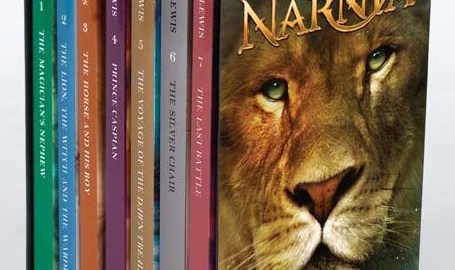
The Chronicles of Narnia is a collection of 7 novels written by C S Lewis, which tells the story of various events that happened in the fictional land of Narnia and beyond. For those who have no idea what the books are about or don’t exactly get the reason behind the titles, here’s a brief explanation and a few relevant quotes. Please note that there are a few spoilers here.


Book 1: The Magician’s Nephew (MN)

666ddda1584a358b467657687d2aa66bThe magician’s nephew refers to Digory, the main character in this book, who will become Professor Kirke in the next book.
Digory is the nephew of Uncle Andrew Ketterley, a minor magician, who was able to make rings that have the power to bring one to the magical world of Atlantis, which was actually the “wood between the worlds.” From this wood, the children – that is, Digory and his neighbor, Polly Plummer – were able to enter the world of Narnia.

[talking to Uncle Andrew] “But there’s one thing I jolly well mean to say first. I didn’t believe in magic till today. I see now it’s real. Well if it is, I suppose all the old fairy tales are more or less true. And you’re simply a wicked, cruel MAGICIAN like the ones in the stories. Well, I’ve never read a story in which people of that sort weren’t paid out in the end, and I bet you will be. And serve you right.” – Digory, from chapter 2 of MN

Book 2: The Lion, the Witch and the Wardrobe (LWW)

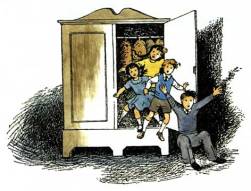
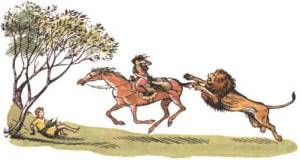
wardrobe-baynesThe Lion in the title is of course, Aslan, who is the parallel of Jesus in that world. The witch is Jadis (whom we first meet in MN) who used to rule in the dead world of Charn. At the time of this story, Jadis has been known in all Narnia as the white witch, and represents all that is evil in the world. The wardrobe was the way in which the four Pevensies – Peter, Susan, Edmund and Lucy – were able to enter the world of Narnia.
And now a very curious thing happened… At the name of ASLAN each one of the children felt something jump in its inside. Edmund felt a sensation of mysterious horror. Peter felt suddenly brave and adventurous. Susan felt as if some delicious smell or some delightful strain of music had just floated by her. And Lucy got the feeling you have when you wake up in the morning and realize that it is the beginning of the holidays or the beginning of summer. – from chapter 7 of LWW

“The WHITE WITCH?” said Edmund. “Who’s she?”

“She is a perfectly terrible person,” said Lucy. “She calls herself the queen of Narnia though she has no right to be queen at all… And she can turn people into stone and do all kinds of horrible things. And she has made a magic so that it is always winter in Narnia – always winter, but it never gets to Christmas.” – from chapter 4 of LWW  

For when Digory was quite middle-aged…, there was a great storm all over the south of England which blew the tree down. He couldn’t bear to have it simply chopped up for firewood, so he had part of the timber made into a WARDROBE, which he put in his big house in the country. And though he himself did not discover the magic properties of that wardrobe, someone else did. That was the beginning of all the comings and goings between Narnia and our world, which you can read of in other books. – from chapter 15 of MN

Book 3: The Horse and His Boy (HHB)

71013-_24The horse in the title should get an award for the longest, most interesting name in all Narnia – Breeny-heeny-breeny-hoohy-ha, or Bree for short. He is a Talking Horse who was captured in his youth and was forced to live and work in the distant land of Calormen. Desiring to return to Narnia, he escaped with a boy named Shasta. The reason why the title is “The Horse and His Boy” instead of “The Boy and His Horse” is that Bree pointed out early on to the proud Aravis, the girl who joined them in their escape, that Talking Horses are free Narnians, and so do not belong to anybody.
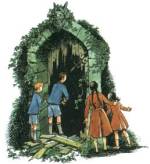
“Why do you keep talking to my horse instead of to me?” asked the girl.
“Excuse me, tarkheena,” said Bree (with just the slightest backward tilt of his ears), “but that’s Calormene talk. We’re free Narnians, Hwin and I, and I suppose, if you’re running away to Narnia, you want to be one too. In that case Hwin isn’t your horse any longer. One might just as well say you’re her human.” – from chapter 2 of HHB

Book 4: Prince Caspian (PC)

1010860-_7This is the most obvious of all the titles, and needs the least explanation. The book tells of the adventures of Prince Caspian the Tenth, and how he became the rightful king of Narnia against his dangerous Uncle Miraz.
“This is CASPIAN, sir,” he said. And Caspian knelt and kissed the Lion’s paw.
“Welcome, PRINCE,” said Aslan. “Do you feel yourself sufficient to take up the kingship of Narnia?”
“I – I don’t think I do, sir,” said Caspian. “I’m only a kid.”
“Good,” said Aslan. “If you had felt yourself sufficient, it would have been a proof that you were not. Therefore, under us and under the High King, you shall be king of Narnia, Lord of Cair Paravel, and Emperor of the Lone Islands. You and your heirs while your race lasts.” – from chapter 15 of PC

Book 5: The Voyage of the Dawn Treader (VDT)

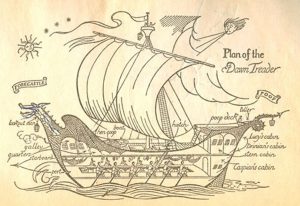
The title pertains to the adventures of the Dawn Treader, which was the name of the ship that King Caspian built in order to find the seven lords (his father’s friends) who sailed off to the east during the time of Miraz. This is a proper adventure story, with exciting things happening in each island.

       “Well,” said Caspian, “that’s rather a long story. Perhaps you remember that when I was a child my usurping Uncle Miraz got rid of seven friends of my father’s (who might have taken my part) by sending them off to explore the unknown eastern seas beyond the Lone Islands.”
       “Yes,” said Lucy, “and none of them ever came back.”
       “Right. Well, on, my coronation day, with Aslan’s approval, I swore an oath that, if once I established peace in Narnia, I would sail east myself for a year and a day to find my father’s friends or to learn of their deaths and avenge them if I could.” – from chapter 2 of VDT

Book 6: The Silver Chair (SC)

Puddleglum-the-MarshwiggleThe silver chair in the title pertains to the magical chair which was used by the Lady of the Green Kirtle, also called the Queen of the Underland or the Emerald Witch. She had the enchanted Prince Rilian, who was the son of King Caspian the Tenth, tied down on this chair during the hour when the enchantment was lifted and he returned to his right mind. This book introduces my all-time favorite literary character – a marshwiggle named Puddleglum.
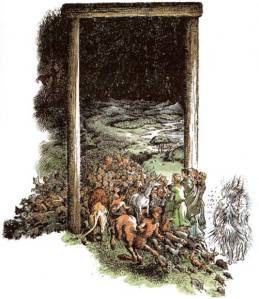
       “The knight was seated in a curious SILVER CHAIR, to which he was bound by his ankles, his knees, his elbows, his wrists, and his waist. There was sweat on his forehead and his face was filled with anguish.” – from chapter 11 of SC

Book 7: The Last Battle (LB)

71299-_40The title pertains to the final battle in the history of Narnia, which was between the Calormene army and the Narnians who fought on the side of King Tirian. It is the darkest story in the series, but has the most beautiful ending.
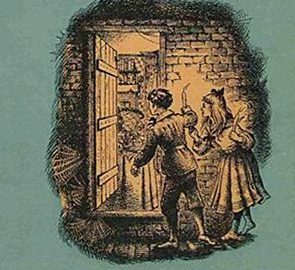

There stood his heart’s desire, huge and real, the golden Lion, Aslan himself, and already the others were kneeling in a circle round his forepaws and burying their hands and faces in his mane as he stooped his great head to touch them with his tongue. Then he fixed his eyes upon Tirian, and Tirian came near, trembling, and flung himself at the Lion’s feet, and the Lion kissed him and said, “Well done, last of the kings of Narnia who stood firm at the darkest hour.” – fom chapter 13 of LB

Narnia: Quotes from The Magician’s Nephew (Part 1)

Here are my favorite quotes from chapters 1-5 of The Magician’s Nephew.

Quotes from CHAPTER 1 – THE WRONG DOOR

“It’s all rot to say a house would be empty all those years unless there was some mystery.”

“Daddy thought it must be the drains,” said Polly.

“Pooh! Grown-ups are always thinking of uninteresting explanations,” said Digory.

“It’s not every day that I see a little girl in my dingy old study; especially, if I may say so, such a very attractive young lady as yourself.”

Polly began to think he might not really be mad after all.

Quotes from CHAPTER 2 – DIGORY AND HIS UNCLE

“None of that!” he hissed in Digory’s ear. “If you start making a noise your Mother’ll hear it. And you know what a fright might do to her.”

As Digory said afterwards, the horrible meanness of getting at a chap in that way, almost made him sick. But of course he didn’t scream again.

It was not at all a nice face, Digory thought, though of course with those early photographs one could never really tell.

“That promise I did not keep.”

“Well, then, it was jolly rotten of you,” said Digory

“You mean that little boys ought to keep their promises. Very true: most right and proper, I’m sure, and I’m very glad you have been taught to do it. But of course you must understand that rules of that sort, however excellent they may be for little boys – and servants – and women – and even people in general, can’t possibly be expected to apply to profound students and great thinkers and sages. No, Digory. Men like me, who possess hidden wisdom, are freed from common rules just as we are cut off from common pleasures. Ours, my boy, is a high and lonely destiny.”

As he said this he sighed and looked so grave and noble and mysterious that for a second Digory really thought he was saying something rather fine. But then he remembered the ugly look he had seen on his Uncle’s face the moment before Polly had vanished: and all at once he saw through Uncle Andrew’s grand words. “All it means,” he said to himself, “Is that he thinks he can do anything he likes to get anything he wants.”

“Well why didn’t you go yourself then?”

Digory had hardly ever seen anyone so surprised and offended as his Uncle did at this simple question. “Me? Me?” he exclaimed. “The boy must be mad! A man at my time of life, and in my state of health, to risk the shock and the dangers of being flung suddenly into a different universe? I never heard anything so preposterous in my life! Do you realize what you’re saying? Think what Another World means – you might meet anything anything.”

“And I suppose you’ve sent Polly into it then,” said Digory. His cheeks were flaming with anger now. “And all I can say,” he added, “even if you are my Uncle – is that you’ve behaved like a coward, sending a girl to a place you’re afraid to go to yourself.”

“Silence, sir!” said Uncle Andrew, bringing his hand down on the table. “I will not be talked to like that by a little, dirty, schoolboy. You don’t understand.”

“Very well. I’ll go. But there’s one thing I jolly well mean to say first. I didn’t believe in Magic till today. I see now it’s real. Well if it is, I suppose all the old fairy tales are more or less true. And you’re simply a wicked, cruel magician like the ones in the stories. Well, I’ve never read a story in which people of that sort weren’t paid out in the end, and I bet you will be. And serve you right.”

“Oh very well then. Just as you please. Go down and have your dinner. Leave the little girl to be eaten by wild animals or drowned or starved in Otherworld or lost there for good, if that’s what you prefer. It’s all one to me. Perhaps before tea time you’d better drop in on Mrs. Plummer and explain that she’ll never see her daughter again; because you were afraid to put on a ring.”

“By gum,” said Digory, “don’t I just wish I was big enough to punch your head!”

Then he buttoned up his coat, took a deep breath, and picked up the ring. And he thought then, as he always thought afterwards too, that he could not decently have done anything else.

Quotes from CHAPTER 3 – THE WOOD BETWEEN THE WORLDS

“It was a rich place: as rich as plumcake.”

“It’s a good thing one of us has some sense,” said Polly.

“Well don’t keep on gassing about it,” said Digory.

Quotes from CHAPTER 4 – THE BELL AND THE HAMMER

“There’s not much point in finding a magic ring that lets you into other worlds if you’re afraid to look at them when you’ve got there.”

These were very solemn faces. You felt you would have to mind your P’s and Q’s, if you ever met living people who looked like that.

Years afterwards when he was an old man, Digory said he had never in all his life known a woman so beautiful. It is only fair to add that Polly always said she couldn’t see anything specially beautiful about her.

“Make your choice, adventurous Stranger;
Strike the bell and bide the danger,
Or wonder, till it drives you mad,
What would have followed if you had.”

“I expect anyone who’s come as far as this is bound to go on wondering till it sends him dotty. That’s the Magic of it, you see. I can feel it beginning to work on me already.”

“Well I don’t,” said Polly crossly. “And I don’t believe you do either. You’re just putting it on.”

“That’s all you know,” said Digory. “It’s because you’re a girl. Girls never want to know anything but gossip and rot about people getting engaged.”

“You looked exactly like your Uncle when you said that,” said Polly.

“Why can’t you keep to the point?” said Digory. “What we’re talking about is -“

“How exactly like a man!” said Polly in a very grownup voice; but she added hastily, in her real voice, “And don’t say I’m just like a woman, or you’ll be a beastly copy-cat.”

“I should never dream of calling a kid like you a woman,” said Digory loftily.

“Oh, I’m a kid, am I?” said Polly who was now in a real rage. “Well you needn’t be bothered by having a kid with you any longer then. I’m off. I’ve had enough of this place. And I’ve had enough of you too – you beastly, stuck-up, obstinate pig!”

Quotes from CHAPTER 5 – THE DEPLORABLE WORD

Low down and near the horizon hung a great, red sun, far bigger than our sun. Digory felt at once that it was also older than ours: a sun near the end of its life, weary of looking down upon that world.

“I had forgotten that you are only a common boy. How should you understand reasons of State? You must learn, child, that what would be wrong for you or for any of the common people is not wrong in a great Queen such as I. The weight of the world is on our shoulders. We must be freed from all rules. Ours is a high and lonely destiny.”

Digory suddenly remembered that Uncle Andrew had used exactly the same words. But they sounded much grander when Queen Jadis said them; perhaps because Uncle Andrew was not seven feet tall and dazzlingly beautiful.

“You are lying,” said the Queen. “Does not Magic always go with the royal blood? Who ever heard of common people being Magicians? I can see the truth whether you speak it or not. Your Uncle is the great King and the great Enchanter of your world. And by his art he has seen the shadow of my face, in some magic mirror or some enchanted pool; and for the love of my beauty he has made a potent spell which shook your world to its foundations and sent you across the vast gulf between world and world to ask my favour and to bring me to him. Answer me: is that not how it was?”

“Well, not exactly,” said Digory.

“Not exactly,” shouted Polly. “Why, it’s absolute bosh from beginning to end.”

Double Lucy Quotes

I was listening to the audiobook of The Lion, the Witch and the Wardrobe today, and noticed that Lucy had two double quotes in LWW – meaning, she said a word twice (I didn’t count quotes like “Aslan, Aslan”). I also remember one double quote in The Voyage of the Dawn Treader, and since I have nothing better to do, I’m posting them here.

“I don’t care what you think, and I don’t care what you say. You can tell the Professor or you can write to Mother or you can do anything you like. I know I’ve met a Faun in there and – I wish I’d stayed there and you are all beasts, beasts.” (LWW, Chapter 5)

“Oh, how can they?” said Lucy, tears streaming down her cheeks. “The brutes, the brutes!” for now that the first shock was over the shorn face of Aslan looked to her braver, and more beautiful, and more patient than ever. (LWW, Chapter 14)

“Oh, the funnies, the funnies,” cried Lucy, bursting into laughter. “Did you make them like that?” (VDT, Chapter 11)

I have no idea if there are any more double quotes from Lucy, but I’ll be on the lookout from now on. In case you come across one, please let me know so that I can add it to my list.

Jumbly Quotes from The BFG

If you have no idea who the BFG is, you should check out my previous blog entry here. The BFG is a nice, jumbly giant who “kidsnatched” the orphan Sophie because she saw him by accident. She learned from him that he was not a “cannibully” giant who ate “human beans,” which apparently taste differently when they’re from different cities or countries.

“Bonecruncher says Turkish human beans has a glamourly flavour. He says Turks from Turkey is tasting of turkey.”

“I suppose they would,” Sophie said.

“Of course they would!” the Giant shouted. “Every human bean is diddly and different. Some is scrumdiddlyumptious and some is uckyslush. Greeks is all full of uckyslush. No Giants is eating Greeks, ever.”

“Why not?” Sophie asked.

“Greeks from Greece is all tasting greasy,” the Giant said….

“As I am saying,” the Giant went on, “all human beans is having different flavours. Human beans from Panama is tasting very strong of hats.”

“Why hats?” Sophie said.

“You is not very clever,” the Giant said, moving his great ears in and out. “I thought all human beans is full of brains, but your head is emptier than a bundongle….”

“The human bean,” the Giant went on, “is coming in dillions of different flavours. For instance, human beans from Wales is tasting very whooshey of fish. There is something very fishy about Wales.”

“You mean whales,” Sophie said. “Wales is something quite different.”

“Wales is whales,” the Giant said. “Don’t gobblefunk around with words. I will now give you another example. Human beans from Jersey has a most disgustable woolly tickle on the tongue,” the Giant said. “Human beans from Jersey is tasting of cardigans.”

“You mean jerseys,” Sophie said.

“You are once again gobblefunking!” the Giant shouted. “Don’t do it! This is a serious and snitching subject. May I continue.”

“Please do,” Sophie said.

“Danes from Denmark is tasting ever so much of dogs,” the Giant went on.

“Of course,” Sophie said. “They taste of great danes.”

“Wrong!” cried the Giant,  slapping his thigh. “Danes from Denmark is tasting doggy because they is tasting of labradors!”

“The what do the people of Labrador taste of?” Sophie asked.

“Danes,” the Giant cried, triumphantly. “Great danes!”

“Aren’t you getting a bit mixed up?” Sophie said.

“I is a very mixed up Giant,” the Giant said. “But I does do my best. And I is not nearly as mixed up as the other giants. I know one who gallops all the way to Wellington for his supper.”

“Wellington?” Sophie said. “Where is Wellington?”

“Your head is full of squashed flies,” the Giant said. “Wellington is in New Zealand. The human beans in Wellington has an especially scrumdiddlyumptious taste, so says the Welly-eating Giant.”

“What do the people of Wellington taste of?” Sophie asked.

“Boots,” the Giant said.

Heehee. That was a long passage (with some parts chopped off – note the ellipses I put in), but I couldn’t resist. The other quotes are a bit shorter, I promise.

“I’m not sure I quite know what that means,” Sophie said.

“Meanings is not important,” said the BFG. “I can’t be right all the time. Quite often I is left instead of right.”

Here’s how the BFG described the other “cannibully” giants:

“All of those man-eating giants is enormous and very fierce! They is all at least two times my wideness and double my royal highness!”

What he means (in case you didn’t quite get it) is that the other giants are twice as wide and high as he is. After all, as the BFG himself says, “Twenty-four feet is puddlenuts in Giant Country.” But don’t listen to everything he says. As he warned Sophie:

“If you listen to everything I am saying you will be getting earache.”

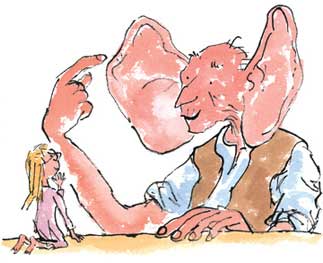
And speaking of ears, you may have noticed the abnormally large ears the BFG has.

“They maybe is looking a bit propsposterous to you,” the BFG said, “but you must believe me when I say they is very extra-usual ears indeed. They is not to be coughed at.”

“I’m quite sure they’re not,” Sophie said.

Big ears or not, the BFG needs to eat. Since he doesn’t want to eat “human beans,” he must settle for an “icky-poo” vegetable called the “snozzcumber.”

“If I dont, I will be nothing but skin and groans.”

“You mean skin and bones,” Sophie said.

Sophie didn’t want to taste it at first, and asked if she really had to eat the dreadful snozzcumber.

“You do unless you is wanting to become so thin you will be disappearing into a thick ear.”

“Into thin air,” Sophie said.

But even though he has to live on snozzcumber (that tastes like rotten fish and frogskins), at least the BFG has a sweet and jumbly fizzy drink called the frobscottle. Unlike our fizzy drinks however, the bubbles go down instead of go up. Upon learning of this, the BFG reacted vehemently.

“Catasterous!” cried the BFG. “Upgoing bubbles is a catasterous disastrophe!”

The problem with talking loudly with Sophie inside his cave is that the other giants became suspicious, and asked him who he was talking to, getting “suspichy” that he is keeping “human beans” as pets. The BFG tried to bluff his way out of it.

“You is welcome to go and search my cave from frack to bunt,” the BFG answered. “You can go looking into every crook and nanny. There is no human beans or stringy beans or runner beans or jelly beans or any other beans in there.”

They had a close call with the other giants, who turned out to be not only “cannibullys” (cannibals), but real bullies as well when it comes to the BFG.

“I didn’t like that,” she said.

“Phew!” said the BFG. “Phew and far between!”

Sophie later learned that the BFG was a dream-collector. He took him with her in the pale country where you can hear dreams sailing along if you have such “propsposterous” ears as the BFG.

“Where are we?” she asked.

“We is in Dream Country,” the BFG said. “This is where all dreams is beginning.”

Unfortunately, sometimes what he catches are not good dreams (or “phizzwizards”), but nightmares as well (or “trogglehumpers”).

“Oh no!” he cried. “Oh mince my maggots! Oh swipe my swoggles!”

“What’s the matter?” Sophie asked.

“It’s a trogglehumper!” he shouted. His voice was filled with fury and anguish. “Oh, save our solos!” he cried. “Deliver us from weasels! The devil is dancing on my dibbler!”

While talking about dreams, Sophie made the interesting discovery that most giants only sleep for two or three hours per day.

“When do you sleep?” Sophie asked.

“Even less,” the BFG answered. “I is sleeping only once in a blue baboon.”

After some time, Sophie asked the BFG how he learned how to write, and found out that he had a Charles Dickens novel for the past 80 years.

“I is reading it hundreds of times,” the BFG said. “And I is still reading it and teaching new words to myself and how to write them. It is the most scrumdiddlyumptious story.”

“Sophie took the book out of his hand.” “Nicholas Nickleby,” she read aloud.

“By Dahl’s Chickens,” the BFG said.

The BFG and Sophie, upon hearing that the other giants were off to England to eat schoolchildren, began to hatch an idea to stop the giants. They went to the Queen of England to ask for her help.

“Your Majester,” he said. “I is your humbug servant…. Oh Queen! Oh Monarcher! Oh, Golden Sovereign! Oh, Ruler! Oh, Ruler of Straight Lines!” 

I will not give away how the story ends, but it’s definitely worth getting a copy of The BFG.

Favourite Scenes from The Scarlet Pimpernel

In my previous blog entry, I talked a bit about one of my favorite books, The Scarlet Pimpernel by Baroness Emma Orczy. Here are some of my favorite scenes that made me fall in love with the character of Sir Percy Blakeney. If you haven’t read the book yet and intend to do so – do NOT read this. SPOILER ALERT!


From Chapter 7 – The Secret Orchard

This is the conversation between Marguerite and her brother Armand, where she admitted her estrangement to her husband, and the selfish reasons why she married him in the first place when they did not seem intellectually matched.

“Does Sir Percy Blakeney know that… I mean, does he know the part you played in the arrest of the Marquis de St. Cyr?” 

She laughed – a mirthless, bitter, contemptuous laugh, which was like a jarring chord in the music of her voice.  

“That I denounced the Marquis de St. Cyr, you mean, to the tribunal that ultimately sent him and all his family to the guillotine? Yes, he does know… I told him after I married him…”

“You told him all the circumstances – which so completely exonerated you from any blame?”

“It was too late to talk of ‘circumstances’; he heard the story from other sources; my confession came too tardily, it seems. I could no longer plead extenuating circumstances: I could not demean myself by trying to explain -“

“And?”

And now I have the satisfaction, Armand, of knowing that the biggest fool in England has the most complete contempt for his wife.”

She spoke with vehement bitterness this time, and Armand St. Just, who loved her so dearly, felt that he had placed a somewhat clumsy finger upon an aching wound.

“But Sir Percy loved you, Margot,” he repeated gently.

“Loved me? – Well, Armand, I thought at one time that he did, or I should not have married him. I daresay,” she added, speaking very rapidly, as if she were about to lay down a heavy burden, which had oppressed her for months, “I daresay that even you thought-as everybody else did – that I married Sir Percy because of his wealth – but I assure you, dear, that it was not so. He seemed to worship me with a curious intensity of concentrated passion, which went straight to my heart. I had never loved any one before, as you know, and I was four-and-twenty then – so I naturally thought that it was not in my nature to love. But it has always seemed to me that it must be heavenly to be loved blindly, passionately, wholly… worshipped, in fact – and the very fact that Percy was slow and stupid was an attraction for me, as I thought he would love me all the more. A clever man would naturally have other interests, an ambitious man other hopes… I thought that a fool would worship, and think of nothing else. And I was ready to respond, Armand; I would have allowed myself to be worshipped, and given infinite tenderness in return… “

From Chapter 11 – Lord Grenville’s Ball

This is during the Lord Grenville’s ball where the Prince of Wales, a French spy named Chauvelin (who was sent to England to find out the identity of the Scarlet Pimpernel) and the Blakeneys meet.

“Ah, Monseigneur,” said Chauvelin, significantly, “rumour has it in France that your Highness could–an you would–give the truest account of that enigmatical wayside flower.”

He looked quickly and keenly at Marguerite as he spoke; but she betrayed no emotion, and her eyes met his quite fearlessly.

“Nay, man,” replied the Prince, “my lips are sealed! And the members of the league jealously guard the secret of their chief… so his fair adorers have to be content with worshipping a shadow. Here in England, Monsieur,” he added, with wonderful charm and dignity, “we but name the Scarlet Pimpernel, and every fair cheek is suffused with a blush of enthusiasm. None have seen him save his faithful lieutenants. We know not if he be tall or short, fair or dark, handsome or ill-formed; but we know that he is the bravest gentleman in all the world, and we all feel a little proud, Monsieur, when we remember that he is an Englishman.”

“Ah, Monsieur Chauvelin,” added Marguerite, looking almost with defiance across at the placid, sphinx-like face of the Frenchman, “His Royal Highness should add that we ladies think of him as of a hero of old… we worship him… we wear his badge… we tremble for him when he is in danger, and exult with him in the hour of his victory.”

Chauvelin did no more than bow placidly both to the Prince and to Marguerite; he felt that both speeches were intended – each in their way – to convey contempt or defiance. The pleasure-loving, idle Prince he despised: the beautiful woman, who in her golden hair wore a spray of small red flowers composed of rubies and diamonds – her he held in the hollow of hand: he could afford to remain silent and to wait events.

A long, jovial, inane laugh broke the sudden silence which had fallen over everyone.

And we poor husbands,” came in slow, affected accents from gorgeous Sir Percy, “we have to stand by… while they worship a demmed shadow.”

Everyone laughed – the Prince more loudly than anyone. The tension of subdued excitement was relieved, and the next moment everyone was laughing and chatting merrily as the gay crowd broke up and dispersed in the adjoining rooms.

From Chapter 12 – The Scrap of Paper

This was during the same ball, and contains the short funny poem that Sir Percy invented.

There he stood, the moral support, the cool-headed adviser, surrounded by a crowd of brainless, empty-headed young fops, who were even now repeating from mouth to mouth, and with every sign of the keenest enjoyment, a doggerel quatrain which he had just given forth. Everywhere the absurd, silly words met her: people seemed to have little else to speak about, even the Prince had asked her, with a little laugh, whether she appreciated her husband’s latest poetic efforts.

“All done in the tying of a cravat,” Sir Percy had declared to his clique of admirers.

“We seek him here, we seek him there,
Those Frenchies seek him everywhere.
Is he in heaven?–Is he in hell?
That demmed, elusive Pimpernel?”

From Chapter 16 – Richmond

This was after the drive home from the ball, and Marguerite was feeling guilty and troubled about how she helped Chauvelin in his quest to unmask the Scarlet Pimpernel. She also tried to rekindle her husband’s love.

“Sir Percy.”

“Your servant, Madame.”

Is it possible that love can die?” she said with sudden, unreasoning vehemence. “Methought that the passion which you once felt for me would outlast the span of human life. Is there nothing left of that love, Percy… which might help you… to bridge over that sad estrangement?”

His massive figure seemed, while she spoke thus to him, to stiffen still more, the strong mouth hardened, a look of relentless obstinacy crept into the habitually lazy blue eyes.

“With what object, I pray you, Madame?” he asked coldly.

“I do not understand you.”

“Yet `tis simple enough,” he said with sudden bitterness, which seemed literally to surge through his words, though he was making visible efforts to suppress it, “I humbly put the question to you, for my slow wits are unable to grasp the cause of this, your ladyship’s sudden new mood. Is it that you have the taste to renew the devilish sport which you played so successfully last year? Do you wish to see me once more a love-sick suppliant at your feet, so that you might again have the pleasure of kicking me aside, like a troublesome lap-dog?”

She had succeeded in rousing him for the moment: and again she looked straight at him, for it was thus she remembered him a year ago.

“Percy! I entreat you!” she whispered, “can we not bury the past?”

“Pardon me, Madame, but I understood you to say that your desire was to dwell in it.”

“Nay! I spoke not of that past, Percy!” she said, while a tone of tenderness crept into her voice. “Rather did I speak of a time when you loved me still! and I… oh! I was vain and frivolous; your wealth and position allured me: I married you, hoping in my heart that your great love for me would beget in me a love for you… but, alas!…”

The moon had sunk low down behind a bank of clouds. In the east a soft grey light was beginning to chase away the heavy mantle of the night. He could only see her graceful outline now, the small queenly head, with its wealth of reddish golden curls, and the glittering gems forming the small, star-shaped, red flower which she wore as a diadem in her hair.

“Twenty-four hours after our marriage, Madame, the Marquis de St. Cyr and all his family perished on the guillotine, and the popular rumour reached me that it was the wife of Sir Percy Blakeney who helped to send them there.”

“Nay! I myself told you the truth of that odious tale.”

“Not till after it had been recounted to me by strangers, with all its horrible details.”

“And you believed them then and there,” she said with great vehemence, “without a proof or question – you believed that I, whom you vowed you loved more than life, whom you professed you worshipped, that I could do a thing so base as these strangers chose to recount. You thought I meant to deceive you about it all – that I ought to have spoken before I married you: yet, had you listened, I would have told you that up to the very morning on which St. Cyr went to the guillotine, I was straining every nerve, using every influence I possessed, to save him and his family. But my pride sealed my lips, when your love seemed to perish, as if under the knife of that same guillotine. Yet I would have told you how I was duped! Aye! I, whom that same popular rumour had endowed with the sharpest wits in France! I was tricked into doing this thing, by men who knew how to play upon my love for an only brother, and my desire for revenge. Was it unnatural?”

Her voice became choked with tears. She paused for a moment or two, trying to regain some sort of composure. She looked appealingly at him, almost as if he were her judge. He had allowed her to speak on in her own vehement, impassioned way, offering no comment, no word of sympathy: and now, while she paused, trying to swallow down the hot tears that gushed to her eyes, he waited, impassive and still. The dim, grey light of early dawn seemed to make his tall form look taller and more rigid. The lazy, good-natured face looked strangely altered. Marguerite, excited, as she was, could see that the eyes were no longer languid, the mouth no longer good-humoured and inane. A curious look of intense passion seemed to glow from beneath his drooping lids, the mouth was tightly closed, the lips compressed, as if the will alone held that surging passion in check.

Marguerite Blakeney was, above all, a woman, with all a woman’s fascinating foibles, all a woman’s most lovable sins. She knew in a moment that for the past few months she had been mistaken: that this man who stood here before her, cold as a statue, when her musical voice struck upon his ear, loved her, as he had loved her a year ago: that his passion might have been dormant, but that it was there, as strong, as intense, as overwhelming, as when first her lips met his in one long, maddening kiss.

Pride had kept him from her, and, woman-like, she meant to win back that conquest which had been hers before. Suddenly it seemed to her that the only happiness life could every hold for her again would be in feeling that man’s kiss once more upon her lips.

“Listen to the tale, Sir Percy,” she said, and her voice was low, sweet, infinitely tender. “Armand was all in all to me! We had no parents, and brought one another up. He was my little father, and I, his tiny mother; we loved one another so. Then one day–do you mind me, Sir Percy? the Marquis de St. Cyr had my brother Armand thrashed – thrashed by his lacqueys – that brother whom I loved better than all the world! And his offence? That he, a plebeian, had dared to love the daughter of the aristocrat; for that he was waylaid and thrashed. . .thrashed like a dog within an inch of his life! Oh, how I suffered! his humiliation had eaten into my very soul! When the opportunity occurred, and I was able to take my revenge, I took it. But I only thought to bring that proud marquis to trouble and humiliation. He plotted with Austria against his own country. Chance gave me knowledge of this; I spoke of it, but I did not know – how could I guess? – they trapped and duped me. When I realised what I had done, it was too late.”

“It is perhaps a little difficult, Madame,” said Sir Percy, after a moment of silence between them, “to go back over the past. I have confessed to you that my memory is short, but the thought certainly lingered in my mind that, at the time of the Marquis’ death, I entreated you for an explanation of those same noisome popular rumours. If that same memory does not, even now, play me a trick, I fancy that you refused me all explanation then, and demanded of my love a humiliating allegiance it was not prepared to give.”

“I wished to test your love for me, and it did not bear the test. You used to tell me that you drew the very breath of life but for me, and for love of me.”

And to probe that love, you demanded that I should forfeit mine honour,” he said, whilst gradually his impassiveness seemed to leave him, his rigidity to relax; “that I should accept without murmur or question, as a dumb and submissive slave, every action of my mistress. My heart overflowing with love and passion, I asked for no explanation – I waited for one, not doubting – only hoping. Had you spoken but one word, from you I would have accepted any explanation and believed it. But you left me without a word, beyond a bald confession of the actual horrible facts; proudly you returned to your brother’s house, and left me alone… for weeks… not knowing, now, in whom to believe, since the shrine, which contained my one illusion, lay shattered to earth at my feet.”

From Chapter 31 – The Escape

This is the denouement of the story, where Marguerite first comes face to face with Sir Percy – also known as the Scarlet Pimpernel, who was disguised as a Jew. Under disguise, he was beaten up by the men of Chauvelin, while his wife (who had not recognized him at all) watched nearby.

The physical pain of utter weariness was so great, that she hoped confidently her tired body could rest here for ever, after all the turmoil, the passion, and the intrigues of the last few days–here, beneath that clear sky, within sound of the sea, and with this balmy autumn breeze whispering to her a last lullaby. All was so solitary, so silent, like unto dreamland. Even the last faint echo of the distant cart had long ago died away, afar.

Suddenly… a sound… the strangest, undoubtedly, that these lonely cliffs of France had ever heard, broke the silent solemnity of the shore.

So strange a sound was it that the gentle breeze ceased to murmur, the tiny pebbles to roll down the steep incline! So strange, that Marguerite, wearied, overwrought as she was, thought that the beneficial unconsciousness of the approach of death was playing her half-sleeping senses a weird and elusive trick.

It was the sound of a good, solid, absolutely British “Damn!”

The sea gulls in their nests awoke and looked round in astonishment; a distant and solitary owl set up a midnight hoot, the tall cliffs frowned down majestically at the strange, unheard-of sacrilege.

Marguerite did not trust her ears. Half-raising herself on her hands, she strained every sense to see or hear, to know the meaning of this very earthly sound.

All was still again for the space of a few seconds; the same silence once more fell upon the great and lonely vastness.

Then Marguerite, who had listened as in a trance, who felt she must be dreaming with that cool, magnetic moonlight overhead, heard again; and this time her heart stood still, her eyes large and dilated, looked round her, not daring to trust her other sense.

“Odd’s life! but I wish those demmed fellows had not hit quite so hard!”

This time it was quite unmistakable, only one particular pair of essentially British lips could have uttered those words, in sleepy, drawly, affected tones.

“Damn!” repeated those same British lips, emphatically. “Zounds! but I’m as weak as a rat!”

In a moment Marguerite was on her feet.

Was she dreaming? Were those great, stony cliffs the gates of paradise? Was the fragrant breath of the breeze suddenly caused by the flutter of angels’ wings, bringing tidings of unearthly joys to her, after all her suffering, or–faint and ill–was she the prey of delirium?

She listened again, and once again she heard the same very earthly sounds of good, honest British language, not the least akin to whisperings from paradise or flutter of angels’ wings.

She looked round her eagerly at the tall cliffs, the lonely hut, the great stretch of rocky beach. Somewhere there, above or below her, behind a boulder or inside a crevice, but still hidden from her longing, feverish eyes, must be the owner of that voice, which once used to irritate her, but now would make her the happiest woman in Europe, if only she could locate it.

“Percy! Percy!” she shrieked hysterically, tortured between doubt and hope, “I am here! Come to me! Where are you? Percy! Percy!…”

“It’s all very well calling me, m’dear!” said the same sleepy, drawly voice, “but odd’s life, I cannot come to you: those demmed frog-eaters have trussed me like a goose on a spit, and I am weak as a mouse… I cannot get away.”

And still Marguerite did not understand. She did not realise for at least another ten seconds whence came that voice, so drawly, so dear, but alas! with a strange accent of weakness and of suffering. There was no one within sight… except by that rock… Great God!… the Jew! … Was she mad or dreaming?…

His back was against the pale moonlight, he was half crouching, trying vainly to raise himself with his arms tightly pinioned. Marguerite ran up to him, took his head in both her hands… and look straight into a pair of blue eyes, good-natured, even a trifle amused – shining out of the weird and distorted mask of the Jew.

“Percy!… Percy!… my husband!” she gasped, faint with the fullness of her joy. “Thank God! Thank God!”

“La! m’dear,” he rejoined good-humouredly, “we will both do that anon, an you think you can loosen these demmed ropes, and release me from my inelegant attitude.”

She had no knife, her fingers were numb and weak, but she worked away with her teeth, while great welcome tears poured from her eyes, onto those poor, pinioned hands.

“Odd’s life!” he said, when at last, after frantic efforts on her part, the ropes seemed at last to be giving way, “but I marvel whether it has ever happened before, that an English gentleman allowed himself to be licked by a demmed foreigner, and made no attempt to give as good as he got.”

It was very obvious that he was exhausted from sheer physical pain, and when at last the rope gave way, he fell in a heap against the rock.

Marguerite looked helplessly round her.

“Oh! for a drop of water on this awful beach!” she cried in agony, seeing that he was ready to faint again.

“Nay, m’dear,” he murmured with his good-humoured smile, “personally I should prefer a drop of good French brandy! an you’ll dive in the pocket of this dirty old garment, you’ll find my flask… I am demmed if I can move.”

When he had drunk some brandy, he forced Marguerite to do likewise.

“La! that’s better now! Eh! little woman?” he said, with a sigh of satisfaction. “Heigh-ho! but this is a queer rig-up for Sir Percy Blakeney, Bart., to be found in by his lady, and no mistake. Begad!” he added, passing his hand over his chin, “I haven’t been shaved for nearly twenty hours: I must look a disgusting object. As for these curls…”

And laughingly he took off the disfiguring wig and curls, and stretched out his long limbs, which were cramped from many hours’ stooping. Then he bent forward and looked long and searchingly into his wife’s blue eyes.

“Percy,” she whispered, while a deep blush suffused her delicate cheeks and neck, “if you only knew…”

“I do know, dear… everything,” he said with infinite gentleness.

“And can you ever forgive?”

I have naught to forgive, sweetheart; your heroism, your devotion, which I, alas! so little deserved, have more than atoned for that unfortunate episode at the ball.”

“Then you knew?…” she whispered, “all the time…”

“Yes!” he replied tenderly, “I knew… all the time… But, begad! had I but known what a noble heart yours was, my Margot, I should have trusted you, as you deserved to be trusted, and you would not have had to undergo the terrible sufferings of the past few hours, in order to run after a husband, who has done so much that needs forgiveness.”