Tag Archives: narnia

My Thoughts on The Voyage of the Dawn Treader

Usually, after seeing one of the Narnia movies in the theater, I hasten to write my own thoughts and impressions before reading other people’s opinions and other people’s movie reviews. I do this to make sure that I write exactly what I personally think without influence from anyone else.

Unfortunately, for The Voyage of the Dawn Treader, I was too lazy to do this and so I’ve already read the mixed reviews out there on this movie. Well, I’ve seen the latest movie from Narnia franchise both in 3D and 2D, and I personally enjoyed the 2D version better (because I didn’t have to get distracted by the 3D glasses slipping off my nose).

Here are some of my not-so-organized thoughts on the movie.

 “You’re on the DAWN TREADER” (or so says the minotaur)

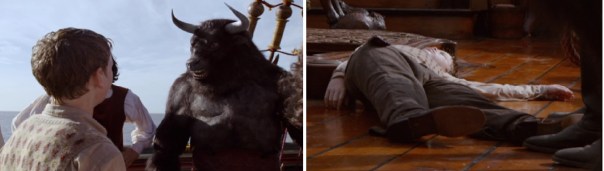
 Let me open with one of the funniest scenes in the movie, when Eustace was hysterically demanding to know where he was, and the minotaur told him that he was on the Dawn Treader. Eustace faints, and the surprised minotaur turns to Caspian and asks, “Was it something I said?”
Eustacetavros

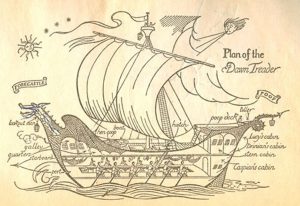
Anyway, I thought I’d dedicate a part in this blog entry about the boat itself, the Dawn Treader. During the production stage, I was looking at how this boat was being built, and I didn’t like it at all, mainly because I thought the dragon head looked scary. Well, come movie time, the Dawn Treader took my breath away – it was so lovely, and grand, and it had a wonderful purple sail!

The Eustace and Reepicheep Show (“It’s a dance, boy!”)

For some reason, there are two major characters in the Narnia books that I never particularly warmed up to – and those two are Eustace and Reepicheep. But this movie completely changed that.
narniavotdt-02

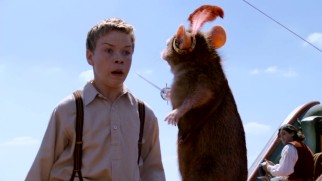
In the movie Prince Caspian, I did not enjoy how they made Reepicheep a comic relief because I felt he was too valiant and proud (in the book version at least), and he took himself too seriously. In The Voyage of the Dawn Treader though, I didn’t mind at all that Reep had so many funny lines. And I particularly loved his line, “We have nothing if not belief.”

There are two scenes involving Eustace that I really loved in the movie, even though they weren’t necessarilyl in the book. The first is the scene where Reepicheep turned the duel into a fencing lesson for Eustace (and Reep tells him, “It’s a dance, boy!” or something to that effect). We see a faint glimmer of the post-dragon Eustace in his initial reaction when Reep congratulated him afterwards, which was a tentative smile, which was of course followed by his defense about how the results would have been different if the playing field was more level.

Another scene I loved was when dragon Eustace grabbed Edmund, dramatically flew around the Dawn Treader, before showing him the words “I am Eustace” on the ground. I also loved how the dragon Eustace resembled the boy Eustace.

When Reep approached the teary eyed dragon who couldn’t sleep, I thought it was the sweetest thing. I also loved how he assured Eustace that extraordinary things happen to extraordinary people.

Another scene that I loved was when dragon Eustace saw the sea serpent and turned around in fright. Reep dropped to his nose and said, “Look at me!” Eustace looks at him sullenly, but did as he was told – he went back to fight.

I really thought these two stole the entire show, and I’m now fully confident that Eustace (or more correctly, Will Poulter) can carry the weight of the next movies on his shoulders (if they ever get made). After all, it will be all Eustace in The Silver Chair and The Last Battle (well, along with Jill Pole of course).

Finally, it’s Caspian, not Cathpian

I am SO glad that Ben Barnes went back to his natural British accent for the movie (and he grew an Aragornish beard as well!). There’s just something about Narnia that always felt British, so it really threw me (and a lot of other fans) off when Prince Caspian appeared on screen with a vaguely Mediterranean accent. Actually, the reason for the accent does make sense, it just didn’t feel right for me.

Edmund and His Never-Ending White Witch Flashbacks

I’m actually okay with all the White Witch flashbacks in Prince Caspian and The Voyage of the Dawn Treader, although a lot of fans are complaining about it. I understand that it’s there because they need a bit of continuity from one movie to another. But then again, the moviemakers need to consider that the Narnia series is a lot different from any of the other fantasy series out there – there are always new major characters in every book. Oh well. Perhaps if I’ve betrayed and nearly killed my siblings  as well as an entire country for turkish delight, I’ll probably have flashbacks for the rest of my life as well.

All in all, I thought Edmund and Lucy were very grown-up and mature in these movies, and they are getting better and looking better as they grow up. But I still liked them both better in The Lion, the Witch and the Wardrobe because there was something so raw and natural about how they acted.

The Swirly Green Mist

Okay, so this was the plot twist I was most worried about. I’m not too happy about it, but I can live with it. I just hope they made it that way and that color as a foreshadowing of the Lady of the Green Kirtle, the villain in the next Narnia movie, The Silver Chair. I just hope that if they ever made that into a movie, they won’t get Tilda Swinton for the role because it would be way too confusing for a lot of movie-goers.

All in all, I was very pleased with this movie, and I hope it earns enough to get the next Narnia movie greenlit. In the meantime, I’m going to do my part to help the movie make money by watching it as many times as I can afford, and getting my friends and family to watch it too. I still have faith that they can make The Silver Chair, mainly because I’d love to see Puddleglum on the big screen. As Reepicheep said, “We have nothing if not belief.”
Narnia: Explaining the Book Titles

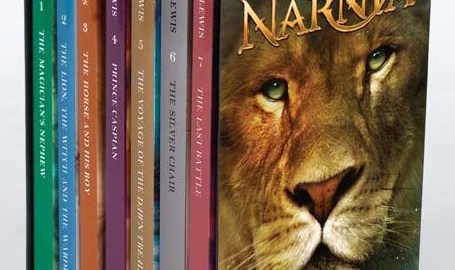
The Chronicles of Narnia is a collection of 7 novels written by C S Lewis, which tells the story of various events that happened in the fictional land of Narnia and beyond. For those who have no idea what the books are about or don’t exactly get the reason behind the titles, here’s a brief explanation and a few relevant quotes. Please note that there are a few spoilers here.


Book 1: The Magician’s Nephew (MN)

666ddda1584a358b467657687d2aa66bThe magician’s nephew refers to Digory, the main character in this book, who will become Professor Kirke in the next book.
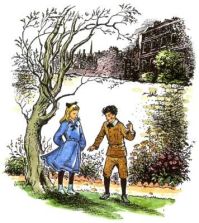
Digory is the nephew of Uncle Andrew Ketterley, a minor magician, who was able to make rings that have the power to bring one to the magical world of Atlantis, which was actually the “wood between the worlds.” From this wood, the children – that is, Digory and his neighbor, Polly Plummer – were able to enter the world of Narnia.

[talking to Uncle Andrew] “But there’s one thing I jolly well mean to say first. I didn’t believe in magic till today. I see now it’s real. Well if it is, I suppose all the old fairy tales are more or less true. And you’re simply a wicked, cruel MAGICIAN like the ones in the stories. Well, I’ve never read a story in which people of that sort weren’t paid out in the end, and I bet you will be. And serve you right.” – Digory, from chapter 2 of MN

Book 2: The Lion, the Witch and the Wardrobe (LWW)

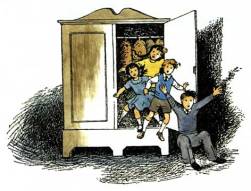
wardrobe-baynesThe Lion in the title is of course, Aslan, who is the parallel of Jesus in that world. The witch is Jadis (whom we first meet in MN) who used to rule in the dead world of Charn. At the time of this story, Jadis has been known in all Narnia as the white witch, and represents all that is evil in the world. The wardrobe was the way in which the four Pevensies – Peter, Susan, Edmund and Lucy – were able to enter the world of Narnia.
And now a very curious thing happened… At the name of ASLAN each one of the children felt something jump in its inside. Edmund felt a sensation of mysterious horror. Peter felt suddenly brave and adventurous. Susan felt as if some delicious smell or some delightful strain of music had just floated by her. And Lucy got the feeling you have when you wake up in the morning and realize that it is the beginning of the holidays or the beginning of summer. – from chapter 7 of LWW

“The WHITE WITCH?” said Edmund. “Who’s she?”

“She is a perfectly terrible person,” said Lucy. “She calls herself the queen of Narnia though she has no right to be queen at all… And she can turn people into stone and do all kinds of horrible things. And she has made a magic so that it is always winter in Narnia – always winter, but it never gets to Christmas.” – from chapter 4 of LWW  

For when Digory was quite middle-aged…, there was a great storm all over the south of England which blew the tree down. He couldn’t bear to have it simply chopped up for firewood, so he had part of the timber made into a WARDROBE, which he put in his big house in the country. And though he himself did not discover the magic properties of that wardrobe, someone else did. That was the beginning of all the comings and goings between Narnia and our world, which you can read of in other books. – from chapter 15 of MN

Book 3: The Horse and His Boy (HHB)

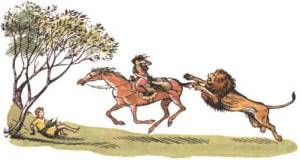
71013-_24The horse in the title should get an award for the longest, most interesting name in all Narnia – Breeny-heeny-breeny-hoohy-ha, or Bree for short. He is a Talking Horse who was captured in his youth and was forced to live and work in the distant land of Calormen. Desiring to return to Narnia, he escaped with a boy named Shasta. The reason why the title is “The Horse and His Boy” instead of “The Boy and His Horse” is that Bree pointed out early on to the proud Aravis, the girl who joined them in their escape, that Talking Horses are free Narnians, and so do not belong to anybody.
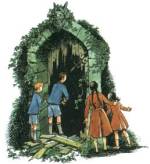
“Why do you keep talking to my horse instead of to me?” asked the girl.
“Excuse me, tarkheena,” said Bree (with just the slightest backward tilt of his ears), “but that’s Calormene talk. We’re free Narnians, Hwin and I, and I suppose, if you’re running away to Narnia, you want to be one too. In that case Hwin isn’t your horse any longer. One might just as well say you’re her human.” – from chapter 2 of HHB

Book 4: Prince Caspian (PC)

1010860-_7This is the most obvious of all the titles, and needs the least explanation. The book tells of the adventures of Prince Caspian the Tenth, and how he became the rightful king of Narnia against his dangerous Uncle Miraz.
“This is CASPIAN, sir,” he said. And Caspian knelt and kissed the Lion’s paw.
“Welcome, PRINCE,” said Aslan. “Do you feel yourself sufficient to take up the kingship of Narnia?”
“I – I don’t think I do, sir,” said Caspian. “I’m only a kid.”
“Good,” said Aslan. “If you had felt yourself sufficient, it would have been a proof that you were not. Therefore, under us and under the High King, you shall be king of Narnia, Lord of Cair Paravel, and Emperor of the Lone Islands. You and your heirs while your race lasts.” – from chapter 15 of PC

Book 5: The Voyage of the Dawn Treader (VDT)

The title pertains to the adventures of the Dawn Treader, which was the name of the ship that King Caspian built in order to find the seven lords (his father’s friends) who sailed off to the east during the time of Miraz. This is a proper adventure story, with exciting things happening in each island.

       “Well,” said Caspian, “that’s rather a long story. Perhaps you remember that when I was a child my usurping Uncle Miraz got rid of seven friends of my father’s (who might have taken my part) by sending them off to explore the unknown eastern seas beyond the Lone Islands.”
       “Yes,” said Lucy, “and none of them ever came back.”
       “Right. Well, on, my coronation day, with Aslan’s approval, I swore an oath that, if once I established peace in Narnia, I would sail east myself for a year and a day to find my father’s friends or to learn of their deaths and avenge them if I could.” – from chapter 2 of VDT

Book 6: The Silver Chair (SC)

Puddleglum-the-MarshwiggleThe silver chair in the title pertains to the magical chair which was used by the Lady of the Green Kirtle, also called the Queen of the Underland or the Emerald Witch. She had the enchanted Prince Rilian, who was the son of King Caspian the Tenth, tied down on this chair during the hour when the enchantment was lifted and he returned to his right mind. This book introduces my all-time favorite literary character – a marshwiggle named Puddleglum.
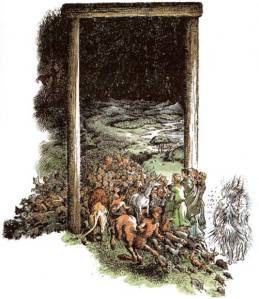
       “The knight was seated in a curious SILVER CHAIR, to which he was bound by his ankles, his knees, his elbows, his wrists, and his waist. There was sweat on his forehead and his face was filled with anguish.” – from chapter 11 of SC

Book 7: The Last Battle (LB)

71299-_40The title pertains to the final battle in the history of Narnia, which was between the Calormene army and the Narnians who fought on the side of King Tirian. It is the darkest story in the series, but has the most beautiful ending.
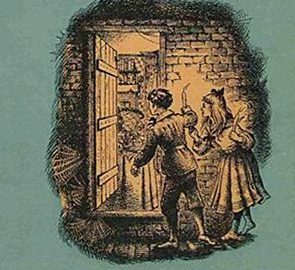
There stood his heart’s desire, huge and real, the golden Lion, Aslan himself, and already the others were kneeling in a circle round his forepaws and burying their hands and faces in his mane as he stooped his great head to touch them with his tongue. Then he fixed his eyes upon Tirian, and Tirian came near, trembling, and flung himself at the Lion’s feet, and the Lion kissed him and said, “Well done, last of the kings of Narnia who stood firm at the darkest hour.” – fom chapter 13 of LB

Narnia Fan Fiction: Letters to Polly (Part 2)

Here’s my second attempt at Narnian fan fiction. I wasn’t sure if I wanted to go on with this, given that Swanwhite already did something quite similar before. However, I noticed that I have a bad habit of not finishing things that I’ve begun, so I decided to finish this off so that I can start my next project, which Lea suggested – a letter from Alberta Scrubb to her friend complaining about the changes she noticed in Eustace. (I guess you can tell I’m beginning to enjoy writing fan fiction).

Anyway, here’s Professor Kirke’s next letter to Polly after hearing about the adventures of the Pevensies in Narnia. If you haven’t read part 1, it would be a good idea to read it first here.

My dear friend Polly,

I told you that I had a feeling that the children would have more adventures in Narnia, and I was right. This morning, I heard a knock on my study door again. It wasn’t a timid knock, like the last time; it was more of a firm rat-tat-tat-tat. I hurriedly opened the door because I had a feeling that it would be the children, and it was. The four children stood quite straight and proper on the hallway, and said, “Good morning, Professor” rather formally. “Good morning, children,” I replied, and looked at each of them solemnly. They looked back at me without blinking, until I asked, “It was Jadis, wasn’t it? I sure hope you have dealt with her before leaving Narnia. It is only quite logical to do so.” They all looked at each other and burst out in laughter, then they bounded inside my study and pulled chairs for themselves.

The entire story tumbled out, with each of the children finishing the other’s sentence. Indeed, the White Witch was our old acquaintance Jadis, just as I feared. I forgot to ask them how she came to be in Narnia in the first place – I mean, what about the Tree of Protection? I must ask Peter tomorrow. Also, hundreds and hundreds of years have already passed since the beginning of Narnia, and there were many kings of Narnia after King Frank. I knew time passed differently there, but I didn’t expect how fast it was compared to ours. 

Anyway, it seems that Edmund did something really bad when they first got there. The other children skirted over the topic and wouldn’t go into details, out of consideration for poor Edmund. I must ask Peter about it in private tomorrow. The result was that Edmund was supposed to die in the hands of Jadis. I asked them what happened, since Edmund was very much alive in front of me and I doubt if Jadis would willingly let him go. There was an awkward silence, until Edmund himself begun to talk in a quiet voice. Did you know what happened next? Aslan himself took Edmund’s place and was killed by the White Witch. Imagine that! I couldn’t believe it at first – remember how Aslan didn’t even flinch when Jadis threw an iron bar at him? How could she hurt him this time, and hurt him enough to kill him? I asked them repeatedly if they were certain that he actually died, but Susan assured me of this point. She is not a liar and is not given to exaggerations, nor is she mad. So I must conclude that what she says is true. There are things about this that I don’t fully understand yet; I really must ask Peter for more details tomorrow.

While I was busy trying to grasp the concept of Aslan dying, Lucy excitedly broke into my thoughts by saying that Aslan did not stay dead – he rose again! She described the scene of his resurrection breathlessly, and I could almost imagine the magic in the air and the music in the winds when it happened. Oh, what I would give to be there with him at that moment! I suddenly remember how he looked at me with tears in his eyes and told me that we must be good to each other, for only we knew what grief was. Perhaps he was thinking forward to the moment when he would have to die for a son of Adam, in order to save all of Narnia.

Aslan (and his army) proceeded to kill the White Witch and defeat her minions, and the four Pevensie children became kings and queens of Narnia. They were there for more than twenty years, until they found themselves back through the wardrobe at the spare room.

At that point, Peter looked sheepish and told me that they were very sorry, but they “borrowed” four coats from the wardrobe since it was very cold on their first day together in Narnia, but they did not know where to find those now. I told them not to worry, and gave them a lot of sage advice which they would do well to remember. I do hope you can come and visit when the opportunity comes, so that you can meet them and hear the story for yourself.

Ever your friend,

Digory Kirke

Photo grabbed from Pinterest at this link.

Narnia Fan Fiction: Letters to Polly (Part 1)

How did Professor Kirke feel when he first heard that Lucy has been to Narnia? Here’s a glimpse through his letter to his old friend. By the way, this is my first attempt at fan fiction of any kind, so any suggestions will be most welcome. You can find part 2 here.

My dear friend Polly,

I hope this letter finds you in the best of health. I must smile a bit while writing your name because indeed, Polly is a funny name. I know you are thinking that it is not half so funny as Digory, and if you were here, we could go on about it, like we did as children.

I’m writing to share with you some news that will surprise you for sure. A month ago, I received a telegram from Mrs. Helen Pevensie of Finchley – I do not know if you remember her, she was a distant relation of my Aunt Letty. It is the usual story – the father is fighting in the war, the air raids are going on about London, and the mother knows their house in the middle of the city is not safe, especially for her children. Mrs. Pevensie cannot leave the house for fear that the dreaded telegram from the War Office should come one day and not find her there, but she implored me to take in her four children since she knew the country is much safer than the city. I remember how you adamantly told me once that London is not a beastly hole, but indeed it is, especially during these trying times.

I had no qualms in agreeing to her request, since it can get lonely out here with only my trusty housekeeper, Mrs. Macready, and the handful of servants to keep me company. You know that even I am a bit afraid of Mrs. Macready, so I thought it would be interesting to suddenly have four bustling children running around the country house.

More than a week ago, the four Pevensie children arrived, and such well-behaved children they were, except for one who is a bit of a rascal. The oldest boy is named Peter, and you’d think he was older than he really was. I reckon it’s because he is the oldest among the four, and so is taking on the role of the absent father for his siblings. The next one is named Susan, quite a lovely young lady and very mature for her age. She reminds me a lot of her mother, Mrs. Pevensie. The third is the rascal I mentioned earlier, who is named Edmund. I will admit something to you and trust that you will not repeat this to anyone else, but this boy Edmund reminds me a lot of myself when I was his age. The youngest is a dear little girl named Lucy, who is a favorite among the servants for her sweet smile and coaxing manners.

I noticed that they made sure never to disturb me – probably one of the rules of Mrs. Macready that I do not know about – except one morning when Peter and Susan knocked timidly at my study door. I hastened to find chairs for them and told them that I was at their disposal, and they begun to share such wonderful news. The youngest child, Lucy, has entered Narnia through the magical wardrobe in my country house! I’m sure you remember that the wardrobe was made from the apple tree I planted years ago, from the apple that Aslan himself handed to me for my sick mother.

While they were telling their story, I could not move out of surprise and a sudden flooding of memories – the Wood between the Worlds, the creation of Narnia, the cabby and the horse Strawberry whom we accidentally brought along – or should we call them King Frank and Fledge now?

Here comes the sad news however. Narnia is under a spell by a powerful enchantress whom Narnians refer to as the White Witch. She is styling herself as the Queen of Narnia, and I wonder whatever happened to King Frank and Queen Helen (remember how she first appeared in Narnia with soapsuds up to her elbows?). We have no idea how Narnian time has passed since we’ve been there last, so this White Witch could be anybody. But I have a sinking feeling that it could be none other than Jadis, the Queen of Charn, whom I woke up from her magical slumber. It is an act I have since regretted much – even though both you and Aslan have graciously forgiven me – but never more so than now.

The older children are afraid that their sister is going mad, because they found nothing special or magical about the wardrobe when they went to investigate. I was surprised that they never even considered the possibility that Lucy is telling the truth, even though it is the most logical explanation. What do they teach at schools these days?

I will write to you again when I have more news. I have a feeling that this is not the end of the children’s adventures in Narnia.

Ever your friend,

Digory Kirke

Photo grabbed from Pinterest at this link.

Narnia: Quotes from The Magician’s Nephew (Part 1)

Here are my favorite quotes from chapters 1-5 of The Magician’s Nephew.

Quotes from CHAPTER 1 – THE WRONG DOOR

“It’s all rot to say a house would be empty all those years unless there was some mystery.”

“Daddy thought it must be the drains,” said Polly.

“Pooh! Grown-ups are always thinking of uninteresting explanations,” said Digory.

“It’s not every day that I see a little girl in my dingy old study; especially, if I may say so, such a very attractive young lady as yourself.”

Polly began to think he might not really be mad after all.

Quotes from CHAPTER 2 – DIGORY AND HIS UNCLE

“None of that!” he hissed in Digory’s ear. “If you start making a noise your Mother’ll hear it. And you know what a fright might do to her.”

As Digory said afterwards, the horrible meanness of getting at a chap in that way, almost made him sick. But of course he didn’t scream again.

It was not at all a nice face, Digory thought, though of course with those early photographs one could never really tell.

“That promise I did not keep.”

“Well, then, it was jolly rotten of you,” said Digory

“You mean that little boys ought to keep their promises. Very true: most right and proper, I’m sure, and I’m very glad you have been taught to do it. But of course you must understand that rules of that sort, however excellent they may be for little boys – and servants – and women – and even people in general, can’t possibly be expected to apply to profound students and great thinkers and sages. No, Digory. Men like me, who possess hidden wisdom, are freed from common rules just as we are cut off from common pleasures. Ours, my boy, is a high and lonely destiny.”

As he said this he sighed and looked so grave and noble and mysterious that for a second Digory really thought he was saying something rather fine. But then he remembered the ugly look he had seen on his Uncle’s face the moment before Polly had vanished: and all at once he saw through Uncle Andrew’s grand words. “All it means,” he said to himself, “Is that he thinks he can do anything he likes to get anything he wants.”

“Well why didn’t you go yourself then?”

Digory had hardly ever seen anyone so surprised and offended as his Uncle did at this simple question. “Me? Me?” he exclaimed. “The boy must be mad! A man at my time of life, and in my state of health, to risk the shock and the dangers of being flung suddenly into a different universe? I never heard anything so preposterous in my life! Do you realize what you’re saying? Think what Another World means – you might meet anything anything.”

“And I suppose you’ve sent Polly into it then,” said Digory. His cheeks were flaming with anger now. “And all I can say,” he added, “even if you are my Uncle – is that you’ve behaved like a coward, sending a girl to a place you’re afraid to go to yourself.”

“Silence, sir!” said Uncle Andrew, bringing his hand down on the table. “I will not be talked to like that by a little, dirty, schoolboy. You don’t understand.”

“Very well. I’ll go. But there’s one thing I jolly well mean to say first. I didn’t believe in Magic till today. I see now it’s real. Well if it is, I suppose all the old fairy tales are more or less true. And you’re simply a wicked, cruel magician like the ones in the stories. Well, I’ve never read a story in which people of that sort weren’t paid out in the end, and I bet you will be. And serve you right.”

“Oh very well then. Just as you please. Go down and have your dinner. Leave the little girl to be eaten by wild animals or drowned or starved in Otherworld or lost there for good, if that’s what you prefer. It’s all one to me. Perhaps before tea time you’d better drop in on Mrs. Plummer and explain that she’ll never see her daughter again; because you were afraid to put on a ring.”

“By gum,” said Digory, “don’t I just wish I was big enough to punch your head!”

Then he buttoned up his coat, took a deep breath, and picked up the ring. And he thought then, as he always thought afterwards too, that he could not decently have done anything else.

Quotes from CHAPTER 3 – THE WOOD BETWEEN THE WORLDS

“It was a rich place: as rich as plumcake.”

“It’s a good thing one of us has some sense,” said Polly.

“Well don’t keep on gassing about it,” said Digory.

Quotes from CHAPTER 4 – THE BELL AND THE HAMMER

“There’s not much point in finding a magic ring that lets you into other worlds if you’re afraid to look at them when you’ve got there.”

These were very solemn faces. You felt you would have to mind your P’s and Q’s, if you ever met living people who looked like that.

Years afterwards when he was an old man, Digory said he had never in all his life known a woman so beautiful. It is only fair to add that Polly always said she couldn’t see anything specially beautiful about her.

“Make your choice, adventurous Stranger;
Strike the bell and bide the danger,
Or wonder, till it drives you mad,
What would have followed if you had.”

“I expect anyone who’s come as far as this is bound to go on wondering till it sends him dotty. That’s the Magic of it, you see. I can feel it beginning to work on me already.”

“Well I don’t,” said Polly crossly. “And I don’t believe you do either. You’re just putting it on.”

“That’s all you know,” said Digory. “It’s because you’re a girl. Girls never want to know anything but gossip and rot about people getting engaged.”

“You looked exactly like your Uncle when you said that,” said Polly.

“Why can’t you keep to the point?” said Digory. “What we’re talking about is -“

“How exactly like a man!” said Polly in a very grownup voice; but she added hastily, in her real voice, “And don’t say I’m just like a woman, or you’ll be a beastly copy-cat.”

“I should never dream of calling a kid like you a woman,” said Digory loftily.

“Oh, I’m a kid, am I?” said Polly who was now in a real rage. “Well you needn’t be bothered by having a kid with you any longer then. I’m off. I’ve had enough of this place. And I’ve had enough of you too – you beastly, stuck-up, obstinate pig!”

Quotes from CHAPTER 5 – THE DEPLORABLE WORD

Low down and near the horizon hung a great, red sun, far bigger than our sun. Digory felt at once that it was also older than ours: a sun near the end of its life, weary of looking down upon that world.

“I had forgotten that you are only a common boy. How should you understand reasons of State? You must learn, child, that what would be wrong for you or for any of the common people is not wrong in a great Queen such as I. The weight of the world is on our shoulders. We must be freed from all rules. Ours is a high and lonely destiny.”

Digory suddenly remembered that Uncle Andrew had used exactly the same words. But they sounded much grander when Queen Jadis said them; perhaps because Uncle Andrew was not seven feet tall and dazzlingly beautiful.

“You are lying,” said the Queen. “Does not Magic always go with the royal blood? Who ever heard of common people being Magicians? I can see the truth whether you speak it or not. Your Uncle is the great King and the great Enchanter of your world. And by his art he has seen the shadow of my face, in some magic mirror or some enchanted pool; and for the love of my beauty he has made a potent spell which shook your world to its foundations and sent you across the vast gulf between world and world to ask my favour and to bring me to him. Answer me: is that not how it was?”

“Well, not exactly,” said Digory.

“Not exactly,” shouted Polly. “Why, it’s absolute bosh from beginning to end.”

On the BBC’s Prince Caspian and Dawn Treader

Like I mentioned in my previous entry, I’ve had the complete VCD collection of the BBC adaptation of The Chronicles of Narnia for 3 years now but I have only attempted to watch it once. I gave up after a few minutes because I was creeped out by the talking beasts – which were actually people wearing animal costumes, until friends from The Lion’s Call forum mentioned how they liked it, especially The Silver Chair. So I dug out my old VCD’s and watched SC, and liked it a lot.

Tonight, having nothing better to do (and not having cable connection at the moment for some reason), I thought I’d watch Prince Caspian and The Voyage of the Dawn Treader, which was meshed to one movie. My major problem is that I can’t find the last disc, so I couldn’t finish watching it. But still, here are my comments:

COMMENTS ON THE CAST

There’s something about Richard Dempsey’s portrayal as PETER PEVENSIE that I really liked. He was younger than I thought Peter would be from the book, but he has a certain kingliness and nobility about him that I could really imagine him as the High King.

Sophie Cook as SUSAN PEVENSIE had only a very short role in the film, and I don’t remember much about it.

Jonathan Scott as EDMUND PEVENSIE was okay, though he looked nearly Peter’s age.

I didn’t like Sophie Wilcox as LUCY PEVENSIE that much, because she didn’t quite capture the innocence and pureness of heart that Georgie Henley was able to portray in the Walt Disney-Walden Media version.

tumblr_m31t7jStt61rssp1to1_500

I loved both the young PRINCE CASPIAN, played by Jean Marc Perret, and the older KING CASPIAN, played by Samuel West. First, because they got the age right. When Caspian became a king, he was only a boy, not a 27 year old man. Second, because they got his hair right. Caspian had golden curls, not raven black wavy hair. Oh well. Plus, I love how the older Caspian resembled the younger Caspian.

As I mentioned before, David Twaithes as EUSTACE SCRUBB captured the whining, irritating quality of the character.

For the minor characters, I’ve got to say I also loved MIRAZ (Robert Lang), CORIAKIN (Preston Lockwood) and best of all, the HAG (which I just found out was played by Barbara Kellerman, who also played the White Witch and the Lady of the Green Kirtle).

COMMENTS ON THE SCRIPT

Again, I must say I’m really impressed with how many direct quotes they incorporated in the dialogue. I guess the main difference is that they combined PC and VDT into pretty much one single story. As I said before, I can’t find the last CD so I don’t know how the story ends, but they thought of a pretty good way to do it. When the Pevensies get back to Narnia after the end of PC, instead of everyone going to school, Peter is going to Professor Kirke’s, Susan to the USA (uh, in a train?) and Ed and Lucy to the house of their cousin Eustace Scrubb. Of course, this leads straight to the story of VDT.

I think though that if you watch this film without reading the book, you’d be hard-pressed to understand the back-story of the Telmarines and the battle.

OTHER COMMENTS

Uh, I thought it was weird for Aslan, Susan and Lucy to watch the second Battle of Beruna rather nonchalantly from the comforts of a tall hill. And I thought the dryads (spirits of the trees) were way too creepy and ghost-like.

I sort of wished I’ve seen the BBC adaptation of The Chronicles of Narnia when I was younger. I’m sure I would have enjoyed it more, but as it is, I still love it.

Practical People in Narnia

In The Chronicles of Narnia, a total of seven people were described as being practical, and three of them were called practical in a rather negative way.

JADIS

The children were now afraid that Jadis would have something to say to them about what had happened in the wood. As it turned out, however, she never mentioned it either then or afterwards. I think (and Digory thinks too) that her mind was of a sort which cannot remember that quiet place at all, and however often you took her there and however long you left her there, she would still know nothing about it. Now that she was left alone with the children, she took no notice of either of them. And that was like her too. In Charn she had taken no notice of Polly (till the very end) because Digory was the one she wanted to make use of. Now that she had Uncle Andrew, she took no notice of Digory. I expect most witches are like that. They are not interested in things or people unless they can use them; they are terribly practical. So there was silence in the room for a minute or two. But you could tell by the way Jadis tapped her foot on the floor that she was growing impatient. – from Chapter 6, “The Beginning of Uncle Andrew’s Troubles,” The Magician’s Nephew

From this quote about Jadis, being practical means only paying attention to someone if you wanted to use the person in one way or another. Jadis didn’t pay attention to Polly because she was using Digory. Later on, she didn’t pay attention to Digory either because she was using Uncle Andrew. She didn’t waste her time in noticing or paying attention to people who didn’t suit her purposes.

UNCLE ANDREW

We must now go back a bit and explain what the whole scene had looked like from Uncle Andrew’s point of view. It had not made at all the same impression on him as on the Cabby and the children. For what you see and hear depends a good deal on where you are standing: it also depends on what sort of person you are.

Ever since the animals had first appeared, Uncle Andrew had been shrinking further and further back into the thicket. He watched them very hard of course; but he wasn’t really interested in seeing what they were doing, only in seeing whether they were going to make a rush at him. Like the Witch, he was dreadfully practical. He simply didn’t notice that Aslan was choosing one pair out of every kind of beasts. All he saw, or thought he saw, was a lot of dangerous wild animals walking vaguely about. And he kept on wondering why the other animals didn’t run away from the big Lion. – from Chapter 9, “The Founding of Narnia,” The Magician’s Nephew

From this quote about Uncle Andrew, being practical means only paying attention to something that involves yourself and nothing more. Uncle Andrew missed the point of the entire creation (or “founding”) of Narnia simply because he was only concerned that that the animals wouldn’t attack him. He didn’t waste his time in noticing or paying attention to things that didn’t concern him directly.

ARSHEESH

Sometimes if Arsheesh was there Shasta would say, “O my Father, what is there beyond that hill?” And then if the fisherman was in a bad temper he would box Shasta’s ears and tell him to attend to his work. Or if he was in a peaceable mood he would say, “O my son, do not allow your mind to be distracted by idle questions. For one of the poets has said, `Application to business is the root of prosperity, but those who ask questions that do not concern them are steering the ship of folly towards the rock of indigence’.”

Shasta thought that beyond the hill there must be some delightful secret which his father wished to hide from him. In reality, however, the fisherman talked like this because he didn’t know what lay to the North. Neither did he care. He had a very practical mind. – from Chapter 1, “How Shasta Set Out on His Travels,” The Horse and His Boy

From this quote about Arsheesh, being practical means only paying attention to something that you already know about. He never concerned himself with the lands beyond, like the free North. He didn’t waste his time in noticing or paying attention to things that he wasn’t familar with.

Being practical isn’t all that bad though. In fact, there were four others who were mentioned as being practical, but not in the way that Jadis, Uncle Andrew and Arsheesh were.

DUFFLE AND THE STAG

Presently, however, two more practical people arrived in the little wood. One was a Red Dwarf whose name appeared to be Duffle. The other was a stag, a beautiful lordly creature with wide liquid eyes, dappled flanks and legs so thin and graceful that they looked as if you could break them with two fingers.

“Lion alive!” roared the Dwarf as soon as he had heard the news. “And if that’s so, why are we all standing still, chattering? Enemies at Anvard! News must be sent to Cair Paravel at once. The army must be called out. Narnia must go to the aid of King Lune.”

“Ah!” said the Hedgehog. “But you won’t find the High King at the Cair. He’s away to the North trouncing those giants. And talking of giants, neighbours, that puts me in mind -” 

“Who’ll take our message?” interrupted the Dwarf. “Anyone here got more speed than me?”

“I’ve got speed,” said the Stag. “What’s my message? How many Calormenes?”

“Two hundred: under Prince Rabadash. And -” But the Stag was already away – all four legs off the ground at once, and in a moment its white stern had disappeared among the remoter trees. – from Chapter 12, “Shasta in Narnia,” The Horse and His Boy

From this quote, being practical means doing what must be done. Upon learning of the coming army of Prince Rabadash, the other creatures didn’t exactly jump into action, but dawdled around chatting about it. Only Duffle, who took control of the situation, and the stag, who rushed to inform the High King, did their part in averting the danger.

SUSAN

“That’s the trouble of it,” said Trumpkin, “when most of the beasts have gone enemy and gone dumb, but there are still some of the other kind left. You never know, and you daren’t wait to see.” …

Lucy shuddered and nodded. When they had sat down she said: “Such a horrible idea has come into my head, Su.”  

“What’s that?”

“Wouldn’t it be dreadful if some day, in our own world, at home, men started going wild inside, like the animals here, and still looked like men, so that you’d never know which were which?”

 “We’ve got enough to bother about here and now in Narnia,” said the practical Susan, “without imagining things like that.” – from Chapter 9, “What Lucy Saw,” Prince Caspian

From this quote, being practical means focusing on the problem on hand. Susan didn’t want to worry about “imaginary” things – she only wanted to deal with those that are “here and now.” Perhaps that became her problem later on – when she got back to England, she only wanted to deal with the “here and now” and convinced herself that Narnia was only imaginary.

EUSTACE

“Why is it called Aslan’s table?” asked Lucy presently.

“It is set here by his bidding,” said the girl, “for those who come so far. Some call this island the World’s End, for though you can sail further, this is the beginning of the end.”

“But how does the food keep?” asked the practical Eustace.

“It is eaten, and renewed every day,” said the girl. “This you will see.” – from Chapter 13, “The Three Sleepers,” The Voyage of the Dawn Treader

From this quote, being practical means asking questions about things that don’t seem to add up logically. Eustace never lost this trait until The Last Battle, which adds charm to his character.

There is a positive and a negative side to being practical. As long as we make sure we’re not like Jadis, Uncle Andrew or Arsheesh, then being practical should be okay.

Double Lucy Quotes

I was listening to the audiobook of The Lion, the Witch and the Wardrobe today, and noticed that Lucy had two double quotes in LWW – meaning, she said a word twice (I didn’t count quotes like “Aslan, Aslan”). I also remember one double quote in The Voyage of the Dawn Treader, and since I have nothing better to do, I’m posting them here.

“I don’t care what you think, and I don’t care what you say. You can tell the Professor or you can write to Mother or you can do anything you like. I know I’ve met a Faun in there and – I wish I’d stayed there and you are all beasts, beasts.” (LWW, Chapter 5)

“Oh, how can they?” said Lucy, tears streaming down her cheeks. “The brutes, the brutes!” for now that the first shock was over the shorn face of Aslan looked to her braver, and more beautiful, and more patient than ever. (LWW, Chapter 14)

“Oh, the funnies, the funnies,” cried Lucy, bursting into laughter. “Did you make them like that?” (VDT, Chapter 11)

I have no idea if there are any more double quotes from Lucy, but I’ll be on the lookout from now on. In case you come across one, please let me know so that I can add it to my list.

A Knight’s Tale from Archenland

This is my first feeble attempt at Narnian poetry, and I wrote this while driving to the office this morning. I guess sometimes traffic is a good thing.

Here is my story, said a knight with a snort,
About what once happened in King Lune’s court.
From out of the blue came two hundred horses –
It was that silly Prince Rabadash’s forces.

But we knew of this Calormene threat beforehand,
We were ready to fight for our dear Archenland.
We had help from our Narnian friends in the battle;
T’was over quickly. And when the dust settled,

A laughter arose – oh what could it be?
The Prince Rabadash, as neat as could be
Got caught in a hook! And now he was screaming
In anger and spite, with his lanky arms flailing.

They took him down, and pondered his fate.
They wanted to free him, but that reprobate
Still shouted at them, full of malice and fury –
Till the Lion showed up and made him a donkey.

Listening to Narnia (Part 2)

As mentioned in my previous entry, I recently bought The Chronicles of Narnia Unabridged Boxed Audiobook Set of HarperCollins for my birthday through Amazon.com. It’s been over a month since I first started listening to it (while driving alone – which I don’t really do that often, I usually have either my brother or boyfriend with me), and I’m now at the last CD of the last book.

Since I’ve already given my comments on the first four audiobooks, here are my comments on the last three.

The Voyage of the Dawn Treader – narrated by Derek Jacobi

I have to admit, VDT is my second least favorite of the Narnia books. One reason is that I never really warmed up to the character of Eustace Scrubb. But Derek Jacobi did an amazing job with him. Pre-dragon Eustace was lofty and annoying, but later became actually… likeable. I particularly loved how he read what dragon Eustace was trying to write in the sand and ended with an exasperated “Oh, bother.” I actually had to double check my book to see if it was really there. It was, but I never noticed it before until Derek Jacobi brought it to life. I didn’t really care for his Lucy voice at the beginning, but it grew on me. I actually cried a bit towards the ending of VDT, when Lucy told Aslan, “It isn’t Narnia, you know… It’s you. We shan’t meet you there. And how can we live, never meeting you?”

The Silver Chair – narrated by Jeremy Northam

I was worried before listening to this because as I have mentioned before, SC is my favorite of the Narnia books, mainly because of its theme (remembering and following the signs) and its main character, Puddleglum the Marshwiggle. Although Puddleglum’s voice was not how I imagined it to be, and the Lady of the Green Kirtle did not trill her R’s as much as I thought she should have, it was nevertheless very well done. The banter between Jill Pole and Eustace Scrubb was always lively.

The Last Battle – narrated by Patrick Stewart

I mentioned in my previous entry that my favorite audiobook was The Magician’s Nephew. After the first chapter of hearing Professor X (Xavier) – er, I mean, Patrick Stewart – reading LB, I knew the people from HarperCollins saved the best for last. Patrick Stewart was amazing. There were particular moments in his reading that really stuck to my mind, such as when the Talking Dogs barked: “Welcome! Welcome! We’ll help, we’ll help, help, help. Show us how to help, show us how, how. How-how-how?” I also loved his voice for Puzzle and Shift and Poggin the Dwarf. He was able to distinguish each voice and give it a character of its own, so you always knew who was talking.

After listening to 30+ hours worth of reading, all I can say is that I can’t wait to start listening all over again!