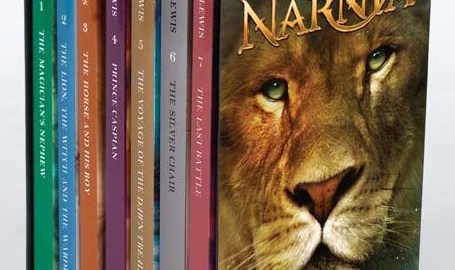
The Chronicles of Narnia is a collection of 7 novels written by C S Lewis, which tells the story of various events that happened in the fictional land of Narnia and beyond. For those who have no idea what the books are about or don’t exactly get the reason behind the titles, here’s a brief explanation and a few relevant quotes. Please note that there are a few spoilers here.
Book 1: The Magician’s Nephew (MN)
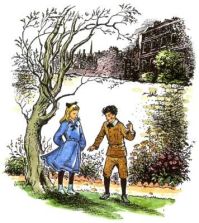 The magician’s nephew refers to Digory, the main character in this book, who will become Professor Kirke in the next book.
Digory is the nephew of Uncle Andrew Ketterley, a minor magician, who was able to make rings that have the power to bring one to the magical world of Atlantis, which was actually the “wood between the worlds.” From this wood, the children – that is, Digory and his neighbor, Polly Plummer – were able to enter the world of Narnia.
[talking to Uncle Andrew] “But there’s one thing I jolly well mean to say first. I didn’t believe in magic till today. I see now it’s real. Well if it is, I suppose all the old fairy tales are more or less true. And you’re simply a wicked, cruel MAGICIAN like the ones in the stories. Well, I’ve never read a story in which people of that sort weren’t paid out in the end, and I bet you will be. And serve you right.” – Digory, from chapter 2 of MN
Book 2: The Lion, the Witch and the Wardrobe (LWW)
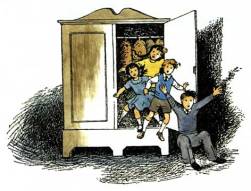 The Lion in the title is of course, Aslan, who is the parallel of Jesus in that world. The witch is Jadis (whom we first meet in MN) who used to rule in the dead world of Charn. At the time of this story, Jadis has been known in all Narnia as the white witch, and represents all that is evil in the world. The wardrobe was the way in which the four Pevensies – Peter, Susan, Edmund and Lucy – were able to enter the world of Narnia.
And now a very curious thing happened… At the name of ASLAN each one of the children felt something jump in its inside. Edmund felt a sensation of mysterious horror. Peter felt suddenly brave and adventurous. Susan felt as if some delicious smell or some delightful strain of music had just floated by her. And Lucy got the feeling you have when you wake up in the morning and realize that it is the beginning of the holidays or the beginning of summer. – from chapter 7 of LWW
“The WHITE WITCH?” said Edmund. “Who’s she?”
“She is a perfectly terrible person,” said Lucy. “She calls herself the queen of Narnia though she has no right to be queen at all… And she can turn people into stone and do all kinds of horrible things. And she has made a magic so that it is always winter in Narnia – always winter, but it never gets to Christmas.” – from chapter 4 of LWW
For when Digory was quite middle-aged…, there was a great storm all over the south of England which blew the tree down. He couldn’t bear to have it simply chopped up for firewood, so he had part of the timber made into a WARDROBE, which he put in his big house in the country. And though he himself did not discover the magic properties of that wardrobe, someone else did. That was the beginning of all the comings and goings between Narnia and our world, which you can read of in other books. – from chapter 15 of MN
Book 3: The Horse and His Boy (HHB)
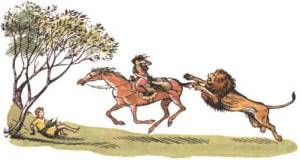 The horse in the title should get an award for the longest, most interesting name in all Narnia – Breeny-heeny-breeny-hoohy-ha, or Bree for short. He is a Talking Horse who was captured in his youth and was forced to live and work in the distant land of Calormen. Desiring to return to Narnia, he escaped with a boy named Shasta. The reason why the title is “The Horse and His Boy” instead of “The Boy and His Horse” is that Bree pointed out early on to the proud Aravis, the girl who joined them in their escape, that Talking Horses are free Narnians, and so do not belong to anybody.
“Why do you keep talking to my horse instead of to me?” asked the girl.
“Excuse me, tarkheena,” said Bree (with just the slightest backward tilt of his ears), “but that’s Calormene talk. We’re free Narnians, Hwin and I, and I suppose, if you’re running away to Narnia, you want to be one too. In that case Hwin isn’t your horse any longer. One might just as well say you’re her human.” – from chapter 2 of HHB
Book 4: Prince Caspian (PC)
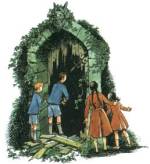 This is the most obvious of all the titles, and needs the least explanation. The book tells of the adventures of Prince Caspian the Tenth, and how he became the rightful king of Narnia against his dangerous Uncle Miraz.
“This is CASPIAN, sir,” he said. And Caspian knelt and kissed the Lion’s paw.
“Welcome, PRINCE,” said Aslan. “Do you feel yourself sufficient to take up the kingship of Narnia?”
“I – I don’t think I do, sir,” said Caspian. “I’m only a kid.”
“Good,” said Aslan. “If you had felt yourself sufficient, it would have been a proof that you were not. Therefore, under us and under the High King, you shall be king of Narnia, Lord of Cair Paravel, and Emperor of the Lone Islands. You and your heirs while your race lasts.” – from chapter 15 of PC
Book 5: The Voyage of the Dawn Treader (VDT)
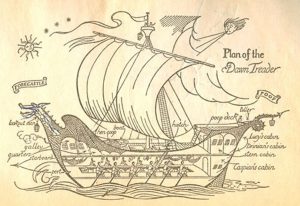 The title pertains to the adventures of the Dawn Treader, which was the name of the ship that King Caspian built in order to find the seven lords (his father’s friends) who sailed off to the east during the time of Miraz. This is a proper adventure story, with exciting things happening in each island.
“Well,” said Caspian, “that’s rather a long story. Perhaps you remember that when I was a child my usurping Uncle Miraz got rid of seven friends of my father’s (who might have taken my part) by sending them off to explore the unknown eastern seas beyond the Lone Islands.”
“Yes,” said Lucy, “and none of them ever came back.”
“Right. Well, on, my coronation day, with Aslan’s approval, I swore an oath that, if once I established peace in Narnia, I would sail east myself for a year and a day to find my father’s friends or to learn of their deaths and avenge them if I could.” – from chapter 2 of VDT
Book 6: The Silver Chair (SC)
 The silver chair in the title pertains to the magical chair which was used by the Lady of the Green Kirtle, also called the Queen of the Underland or the Emerald Witch. She had the enchanted Prince Rilian, who was the son of King Caspian the Tenth, tied down on this chair during the hour when the enchantment was lifted and he returned to his right mind. This book introduces my all-time favorite literary character – a marshwiggle named Puddleglum.
“The knight was seated in a curious SILVER CHAIR, to which he was bound by his ankles, his knees, his elbows, his wrists, and his waist. There was sweat on his forehead and his face was filled with anguish.” – from chapter 11 of SC
Book 7: The Last Battle (LB)
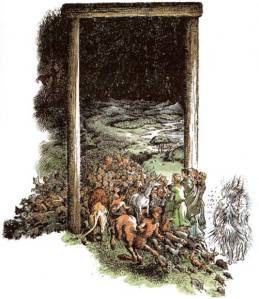 The title pertains to the final battle in the history of Narnia, which was between the Calormene army and the Narnians who fought on the side of King Tirian. It is the darkest story in the series, but has the most beautiful ending.
There stood his heart’s desire, huge and real, the golden Lion, Aslan himself, and already the others were kneeling in a circle round his forepaws and burying their hands and faces in his mane as he stooped his great head to touch them with his tongue. Then he fixed his eyes upon Tirian, and Tirian came near, trembling, and flung himself at the Lion’s feet, and the Lion kissed him and said, “Well done, last of the kings of Narnia who stood firm at the darkest hour.” – fom chapter 13 of LB
 Sunny Feels